Week 1 - Introduction
Examples of how the exercises should be solved
Exercise 1
Daniel throws a ball of mass $m$ to the left at an angle of $\alpha=45^\circ$ to the ground. With what initial velocity $v_0$ does he have to throw the ball so that it travels a distance of $d=10\,\mathrm{m}$? Air resistance is negligible, and you may assume that the ball lands at the same height as the point from which it was thrown.
Solution 1
-
We make a sketch:
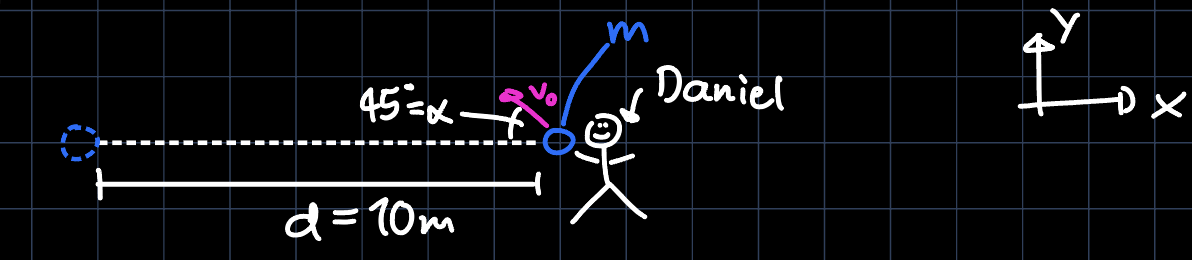
-
Physical conditions:
Since we can neglect air resistance, the only force acting on the ball is gravity. So for the equations of motion we have:
-
Equations of motion:
$$\ddot{x} = 0 \qquad (1x) $$ $$\ddot{y} = -g \qquad (1y) $$
-
Solving the equations:
Integrating (1x) twice gives:
$$x(t) = v_{0,x} t + x_0 \qquad (2x)$$
Integrating (1y) twice gives:
$$y(t) = -\frac{1}{2} g t^2 + v_{0,y} t + y_0 \qquad (2y)$$
Since the ball lands at the same height as the launch point, $y_0 = 0$, and $x_0$ can be dropped, the distance of the landing position from the starting position is what we are looking for. Furthermore, $v_{0,x} = v_0 \cos(\alpha)$ and $v_{0,y} = v_0 \sin(\alpha).$ Now we define $t_{end}$ as the time at which the ball lands and obtain:
$$x(t_{end}) = d \qquad (3x)$$ $$y(t_{end}) = 0 \qquad (3y)$$
Substituting (2x) and (2y) into (3x) and (3y) gives:
$$v_0 \cos(\alpha) t_{end} = d \qquad (4x)$$ $$-\frac{1}{2} g t_{end}^2 + v_0 \sin(\alpha) t_{end} = 0 \qquad (4y)$$
Solving (4x) for $t_{end}$ gives:
$$t_{end} = \frac{d}{v_0 \cos(\alpha)} \qquad (5)$$
Substituting (5) into (4y) gives:
$$-\frac{1}{2} g \left(\frac{d}{v_0 \cos(\alpha)}\right)^2 + v_0 \sin(\alpha) \frac{d}{v_0 \cos(\alpha)} = 0 \qquad (6)$$
Solving (6) for $v_0$ gives:
$$\abs{v_0} = \sqrt{\frac{g d}{2 \sin(\alpha) \cos(\alpha)}}$$
-
Calculating the numerical result:
Plugging in the values $g=9.81\,\mathrm{m/s^2}$, $d=10\,\mathrm{m}$ and $\alpha=45^\circ$ gives:
$$\abs{v_0} = \sqrt{\frac{9.81\,\mathrm{m/s^2} \cdot 10\,\mathrm{m}}{2 \cdot \sin(45^\circ) \cdot \cos(45^\circ)}} \approx 9.9 \,\mathrm{m/s}$$
-
Sanity check:
The unit $\mathrm{m/s}$ corresponds to a velocity, as desired. The magnitude corresponds to a speed of about $36\,\mathrm{km/h}$, which is realistic for a throw that goes $10\, \mathrm{m}$ far.
Exercise 2 - For demonstration only!
In case you don't believe me after Exercise 1 shown in class that it's worth following this scheme, I've made a somewhat harder one here. It is in no way relevant for the exam, though, and only serves to demonstrate the solution scheme.
A skydiver jumps out of an airplane from a great height. The initial velocity is $v_0=0\,\mathrm{m/s}$ and the initial height is $h_0=2000\,\mathrm{m}.$ The mass of the skydiver is $m=100\,\mathrm{kg}.$ The gravitational acceleration is $g=9.81\,\mathrm{m/s^2}$ and can be assumed to be constant. What speed does the skydiver reach when hitting the ground if he does not open the parachute? The air resistance is $F_W = -\frac{1}{2} \rho C_W A v^2$ with $\rho(h)=1.2\,\mathrm{kg/m^3} * 2^{-h/(5500\, \mathrm{m})}$ the density of the air, $C_W=1.4$ the specific (drag) coefficient and $A=1\,\mathrm{m^2}$ the frontal area.
Solution 2
-
We make a sketch:
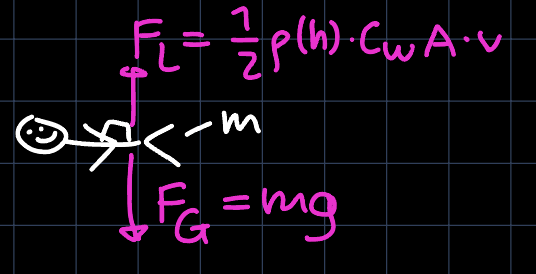
-
Physical conditions:
Since we take air resistance into account, both gravity and air resistance act on the skydiver. Since the initial velocity is $v_0=0\,\mathrm{m/s}$, gravity always acts in the direction of motion and air resistance always acts against the direction of motion. So the effective force is given by the difference of the two forces:
-
Equation of motion:
$$F_{eff} = F_G + F_W = m \ddot{y} \qquad (1)$$
$$F_G = m g \qquad (2)$$
$$F_W(y) = -\frac{1}{2} \rho(y) C_W A \dot{y}^2 \qquad (3)$$
-
Solving the equation of motion:
Substituting (2) and (3) into (1) gives:
$$m g -\frac{1}{2} \rho(y) C_W A \dot{y}^2 = m \ddot{y} \qquad (4)$$
Solving (4) for $\ddot{y}$ gives:
$$\ddot{y} = g - \frac{1}{2 m} \rho(y) C_W A \dot{y}^2 \qquad (5)$$
This is an inhomogeneous second-order differential equation. It is too difficult to solve analytically. So we have two options here:
- Numerical solution with a computer program
- Simplifications through justified assumptions, so that it can be solved analytically
We choose the second option here. We simplify the differential equation by assuming that the density of the air is constant at its value at medium height, $\rho(h) \approx \rho_{avg} = 1.06\,\mathrm{kg/m^3}$. This assumption is well justified, since the density decreases exponentially with height and no great heights are reached.
Substituting $\rho(y) = \rho_{avg}$ into (5) gives:
$$\ddot{y} = g - \frac{1}{2 m} \rho_{avg} C_W A \dot{y}^2 \qquad (6)$$
Since we have now lost the variable $y$, we can make a substitution. We define $v = \dot{y}$ and obtain from (6):
$$\dot{v} = g - \frac{1}{2 m} \rho_{avg} C_W A v^2 \qquad (7)$$
Dividing both sides of (7) by $g - \frac{1}{2 m} \rho_{avg} C_W A v^2$ and integrating using separation of variables gives:
$$\int_{0}^{v(t)} \frac{1}{g - \frac{1}{2 m} \rho_{avg} C_W A v^2} \mathrm{d}v = \int_{0}^{t} 1 \mathrm{d}t' \qquad (8)$$
The right-hand side of (8) is simple and gives:
$$\int_{0}^{t} 1 \mathrm{d}t' = t \qquad (9)$$
On the left-hand side we see that we can simplify using the substitution $u = \sqrt{\frac{A C_W \rho_{avg}}{2 m g}} v$ and $\mathrm{d}u = \sqrt{\frac{A C_W \rho_{avg}}{2 m g}} \mathrm{d}v$:
$$\int \frac{1}{g - \frac{1}{2 m} \rho_{avg} C_W A v^2} \mathrm{d}v = \int \sqrt{\frac{2 m g}{A C_W \rho_{avg}}} \frac{1}{g - g u^2} \mathrm{d}u = \sqrt{\frac{2 m}{A C_W \rho_{avg} g}} \int \frac{1}{1-u^2} \mathrm{d}u \qquad (10)$$
This gives us an integral that can be solved by partial fraction decomposition:
$$\int \frac{1}{1-u^2} \mathrm{d}u = \int \frac{1}{1-u} \frac{1}{1+u} \mathrm{d}u = \int \left(\frac{1}{2(1+u)} - \frac{1}{2(1-u)}\right) \mathrm{d}u \qquad (11)$$
Using the well-known integral $\int \frac{1}{x} \mathrm{d}x = \ln(x) + C$ and the logarithm rule $\ln(a)-\ln(b) = \ln(a/b)$ we obtain:
$$\int \frac{1}{1-u^2} \mathrm{d}u = \frac{1}{2} \ln \left| \frac{1+u}{1-u} \right| + C \qquad (12)$$
By back-substitution and substituting (12) into (10) we obtain the antiderivative:
$$\int \frac{1}{g - \frac{1}{2 m} \rho_{avg} C_W A v^2} \mathrm{d}v = \sqrt{\frac{2 m}{A C_W \rho_{avg} g}} \frac{1}{2} \ln \left| \frac{1+\sqrt{\frac{A C_W \rho_{avg}}{2 m g}} v}{1-\sqrt{\frac{A C_W \rho_{avg}}{2 m g}} v} \right| + C \qquad (13)$$
To keep the expression compact, we introduce new constants: $A_0 = \sqrt{\frac{2 m}{A C_W \rho_{avg} g}}$ and $B_0 = \sqrt{\frac{A C_W \rho_{avg}}{2 m g}}.$ With these we can write the solution as:
$$\int \frac{1}{g - \frac{1}{2 m} \rho_{avg} C_W A v^2} \mathrm{d}v = A_0 \frac{1}{2} \ln \left| \frac{1+B_0 v}{1-B_0 v} \right| + C \qquad (13')$$
Condition (8) with the initial condition $v_0 = 0$ and $\ln(1) = 0$ and the result from (9) gives, together with (13'):
$$t = A_0 \frac{1}{2} \ln \left| \frac{1+B_0 v}{1-B_0 v} \right| \qquad (14)$$
Solving (14) for $v(t)$ gives:
$$v(t) = \frac{1}{B_0} \frac{e^{\frac{2}{A_0} t} - 1}{e^{\frac{2}{A_0} t} + 1} \qquad (15)$$
Now we can make another substitution of the variable names and already bring in a bit of interpretation: $v_{\infty} = \lim_{t \to \infty} v(t) = \frac{1}{B_0}$ is the speed the skydiver would reach if he fell for an infinitely long time. Furthermore, $\tau = \frac{A_0}{2}$ is the time constant, which tells us how quickly the velocity converges to $v_{\infty}$. With this we can write (15) as:
$$v(t) = v_{\infty} \frac{e^{\frac{t}{\tau}} - 1}{e^{\frac{t}{\tau}} + 1} \qquad (16)$$
However, we can't simply assume that the maximum speed is reached; we first have to determine the fall time. We can do this by integrating the velocity and setting it equal to the fall height $h_0$:
$$\int_{0}^{t_{end}} v(t') \mathrm{d}t' = h_0 \qquad (17)$$
Substituting (16) into (17) gives:
$$v_{\infty} \int_{0}^{t_{end}} \frac{e^{\frac{t'}{\tau}} - 1}{e^{\frac{t'}{\tau}} + 1} \mathrm{d}t' = h_0 \qquad (18)$$
With the substitution $u = e^{\frac{t'}{\tau}}$ and $\mathrm{d}u = \frac{1}{\tau} e^{\frac{t'}{\tau}} \mathrm{d}t'$ we obtain:
$$v_{\infty} \int_{1}^{e^{\frac{t_{end}}{\tau}}} \frac{u - 1}{u + 1} \frac{\tau}{u} \mathrm{d}u = h_0 \qquad (19)$$
With the partial fraction decomposition $\frac{u - 1}{u + 1} = 1 - \frac{2}{u + 1}$ and $\int \frac{1}{u} \mathrm{d}u = \ln(u) + C$ we obtain:
$$v_{\infty} \left( \tau \left( \ln(u) - 2 \ln(u + 1) \right) \right) \bigg|_{1}^{e^{\frac{t_{end}}{\tau}}} = h_0 \qquad (20)$$
Plugging in the boundary values gives:
$$v_{\infty} \left( \tau \left( \ln(e^{\frac{t_{end}}{\tau}}) - 2 \ln(e^{\frac{t_{end}}{\tau}} + 1) - \ln(1) + 2 \ln(1 + 1) \right) \right) = h_0 \qquad (21)$$
Which we can solve for $t_{end}$:
$$t_{end} = \tau \ln \left( \frac{h_0}{v_{\infty} \tau} + 1 \right) \qquad (22)$$
Substituting (22) into (16) gives:
$$v(t_{end}) = v_{\infty} \frac{e^{\frac{t_{end}}{\tau}} - 1}{e^{\frac{t_{end}}{\tau}} + 1} = v_{\infty} \frac{\frac{h_0}{v_{\infty} \tau} + 1 - 1}{\frac{h_0}{v_{\infty} \tau} + 1 + 1} = v_{\infty} \frac{\frac{h_0}{v_{\infty} \tau}}{\frac{h_0}{v_{\infty} \tau} + 2} = v_{\infty} \frac{h_0}{h_0 + 2 v_{\infty} \tau} \qquad (23)$$
-
Calculating the numerical result:
If we plug in the given values $\rho_{avg} \approx 1.06\, \mathrm{kg/m^3}$, $h_0 = 2000\, \mathrm{m}$, $g = 9.81\, \mathrm{m/s^2}$, $A = 1\, \mathrm{m^2}$, $C_W = 1.4$ and $m = 100\, \mathrm{kg}$, we obtain:
$$v(t_{end}) \approx 34\, \mathrm{m/s} \approx 123\, \mathrm{km/h}$$
-
Logical interpretation of the result:
We see that the units of the result match a velocity, as expected. The numerical value also makes sense, since it is in the order of magnitude of the speed of a fall with air resistance.
Note: Don't worry, this exercise was clearly above the level expected in the first year. It was only there to show that reasonably realistically formulated problems can get very complicated very quickly, and that a structured approach to solving them is therefore important. Otherwise you quickly lose track and it takes much longer to solve the exercise.
Week 2 - Force Equilibria - Electric and Magnetic
Lecture recap
Nomenclature of atomic nuclei
We have learned that atoms are not 'atomic' (indivisible) after all, but are made up of further elementary particles: protons, electrons and neutrons. The periodic table gives us an atomic number $Z$ (number at the top left) for each element, which corresponds exactly to the number of protons in the nucleus. However, an element can have a different number of neutrons. That's why a nucleus is only uniquely described by the mass number $A$, which is the sum of the number of protons and the number of neutrons. The notation is then $_Z^A X$, where $X$ denotes the symbol of the atom. Examples are: $_8^{16} \mathrm{O}, _7^{14} \mathrm{N}, _6^{12} \mathrm{c}, _6^{13} \mathrm{C}.$
'New units'
To avoid having to calculate with super small numbers, we define new units:
- Atomic mass unit: $1\, \mathrm{u} = \frac{1}{12} m_{^{12}_6 \mathrm{C}}$, _amu on the calculator
- Electron volt: $1\, \mathrm{eV} = |q_e| 1\, \mathrm{V}$ corresponds to the energy needed to accelerate an electron through $1\, \mathrm{V}$.
Example exercises
Floating water
We consider a spherical water droplet with a radius of $5.0\, \mathrm{mm}$ and a charge of $10\, \mathrm{\mu C}.$ Calculate the electric field needed for the droplet to float in the Earth's atmosphere. The density of water is $1000\, \mathrm{kg/m^3}.$
Acceleration in a parallel-plate capacitor
Determine the kinetic energy of a sodium ion that is accelerated in a parallel-plate capacitor with a voltage of $100\, \mathrm{V}$ over a distance of $5\, \mathrm{cm}$. The electric field in a parallel-plate capacitor is constant and is $E = \frac{U}{d}.$
Mass spectrometer
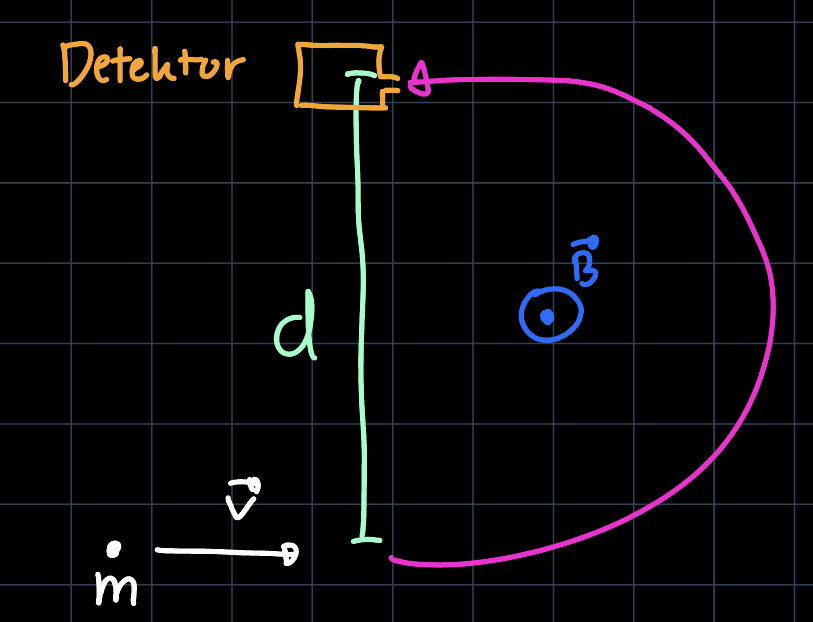
We consider a mass spectrometer as illustrated in the sketch below. A particle that was previously accelerated to $150\, \mathrm{m/s}$ carries the charge $10\, \mathrm{nC}$ and is deflected by a magnetic field $B = 0.5\, \mathrm{T}$ (orthogonal to the velocity) and hits a detector placed $2\, \mathrm{m}$ away. Determine the mass of the particle.
Regression
We look at the number of students at ETH over the last few years and want to find out whether we can predict the number for the future. For this we have the following data (source):
| Year | Number of students |
|---|---|
| 2016 | 18780 |
| 2017 | 19512 |
| 2018 | 20282 |
| 2019 | 21100 |
| 2020 | 22461 |
| 2021 | 23401 |
| 2022 | 23963 |
Think about what relationship you suspect between the two quantities and normalize the data so that you can perform a linear regression. Determine the slope and the y-intercept of the regression line and give the equation of the line. Then calculate the number of students for the year 2023, and at the end of the semester we'll see who made the best prediction.
Solutions
Solution floating water
First we calculate the gravitational force acting on the water droplet:
$$F_G = m g = \frac{4}{3} \pi r^3 \rho g$$
Now we can calculate the required electric force:
$$F_E = q E = 10\, \mathrm{nC} \cdot E$$
For the droplet to float, the electric force must be equal in magnitude to the gravitational force:
$$F_E = F_G \Rightarrow q E = \frac{4}{3} \pi r^3 \rho g \Rightarrow E = \frac{4}{3} \pi r^3 \rho g / q = 513.47... \, \mathrm{N/C} \approx 510\, \mathrm{V/m}$$
Comment on the unit: Since by definition $\mathrm{V} = \mathrm{J/C}$, the last conversion follows.
Solution acceleration in a parallel-plate capacitor
$\Delta E = q U = 1.602176634 \cdot 10^{-19}\, \mathrm{C} \cdot 100\, \mathrm{V} = 1.602176634 \cdot 10^{-17}\, \mathrm{J}$
Solution mass spectrometer
Two forces act here: the Lorentz force $F_L = q v B$ and the centripetal force $F_Z = \frac{m v^2}{r}.$ Since the centripetal force has to balance the Lorentz force, we have:
$$F_L = F_Z \Rightarrow q v B = \frac{m v^2}{r} \Rightarrow m = \frac{q v B r}{v^2} = \frac{q B r}{v} = \frac{10\, \mathrm{nC} \cdot 0.5\, \mathrm{T} \cdot 1\, \mathrm{m}}{150\, \mathrm{m/s}} \approx 3.33\cdot 10^{-11} \, \mathrm{kg}$$
Solution regression
The description here refers to the table below. First, we extend the table with a column for the difference to the previous year.
| Year | Number of students | Difference |
|---|---|---|
| 2016 | 18780 | - |
| 2017 | 19512 | 732 |
| 2018 | 20282 | 770 |
| 2019 | 21100 | 818 |
| 2020 | 22461 | 1361 |
| 2021 | 23401 | 940 |
| 2022 | 23963 | 562 |
The difference shows that there is an increase and then a decrease again -> parabolic function graph ($f(x) = a x^2 + b x + c$). If we set the zero point at the maximum value from the year 2020, we get the parameter $c = 1361$ 'for free', which we subtract right away and look at the difference from it. So now we are looking for a function $g(x) = a x^2 + b x.$ We can divide this by $x$ and thus get our ansatz for a linear regression with the data in the last two columns of the table below:
| Year | Number of students | Difference | Difference to 1361 | Normalized year | Difference divided by year |
|---|---|---|---|---|---|
| 2017 | 19512 | 732 | -629 | -3 | 210 |
| 2018 | 20282 | 770 | -591 | -2 | 296 |
| 2019 | 21100 | 818 | -543 | -1 | 543 |
| 2021 | 23401 | 940 | -421 | 1 | -421 |
| 2022 | 23963 | 562 | -799 | 2 | -400 |
Now we can perform the linear regression and obtain the equation $g(x) = -165 x - 54.$ If we do the previous steps backwards, we get for the difference $f(x) = -165 x^2 - 54 x + 1361.$ So for the year 2023 we get $f(3) = 1361 - 165 \cdot 3^2 - 54 \cdot 3 = 1361 - 1485 - 162 = - 286$, which gives us an increase of $562 - 286 = 276$ students. So according to this prediction we expect $23963 + 276 = 24239$ students in the year 2023. Let's see how close that gets xD.
Week 3 - Angular Momentum - Classical and QM
Lecture recap
Short example on units
Why is it important to pay attention to the units in a calculation? The following example is meant to show where it practically gives you the solution. We want to determine the period $T$ (= oscillation period) of a spring pendulum. We know that it can depend on the gravitational acceleration $g$, the length $l$ and the mass $m$ of the pendulum. If we look at the units of these quantities, we see: $[g] = \mathrm{m/s^2}$, $[l] = \mathrm{m}$ and $[m] = \mathrm{kg}$, as well as the quantity we are looking for, $[T] = \mathrm{s}$. We can now try to find a formula that combines these quantities and has the right unit. With this we directly see $T \propto \sqrt{g l / m},$ and we have solved the problem.
Angular momentum
The angular momentum of an object with momentum $\vec p$ and position vector $\vec r$ with respect to a reference point (usually the origin $(0,0,0)$) is defined as $\vec L = \vec r \times \vec p.$ In most cases we consider a simple system of two point masses where $\vec p$ and $\vec r$ are orthogonal (at right angles/perpendicular) to each other. Then the formula simplifies to $L = r p$ (with the magnitudes of the respective quantities).
Angular momentum is a conserved quantity. This means that as long as no torque acts, the angular momentum stays constant: if an object rotates, it keeps rotating at the same speed. This is also the reason why a spinning top can stand upright or a bicycle rights itself on its own.
Spin
Spin refers to the intrinsic angular momentum of a particle. It is a property of the particle and cannot be changed. It is a quantum mechanical phenomenon and can only be explained by quantum mechanics. For you, the explanation for the spin of an electron is enough: "Electron spin in short: Imagine a ball that’s rotating, except it’s not a ball and it’s not rotating".
Exercises
Coulomb vs. gravitational force
We consider a system of two identical objects of mass $m$ and charge $q$, which are at a distance $r$ from each other. Calculate the ratio $m/q$ at which the Coulomb force and the gravitational force are equal in magnitude. Does it depend on the distance $r$? The gravitational constant is $G = 6.674 \cdot 10^{-11}\, \mathrm{m^3\,kg^{-1}\,s^{-2}}$ and the vacuum permittivity is $\varepsilon_0 = 8.854 \cdot 10^{-12}\, \mathrm{m^{-3}\,kg^{-1}\,s^4\,A^2}.$
Angular momentum quantum numbers (exam HS13)
The naturally occurring isotopes of magnesium are $^{24} \mathrm{Mg}$, $^{25} \mathrm{Mg}$ and $^{26} \mathrm{Mg}.$ Make a table with the numbers of neutrons, protons and electrons of the isotopes and state for each whether the nuclear spin quantum number is zero, integer or half-integer.
Neon combo (exam FS20)
Based on the following table, calculate the natural abundance of all possible isotopomers of the neon dimer $\mathrm{Ne}_2$ (e.g. $^{20}\mathrm{Ne}-^{20}\mathrm{Ne}$).
| Isotope | Mass (u) | natural abundance |
|---|---|---|
| $^{20} \mathrm{Ne}$ | 19.99244 | 90.48% |
| $^{21} \mathrm{Ne}$ | 20.99384 | 0.27% |
| $^{22} \mathrm{Ne}$ | 21.99138 | 9.25% |
Magnetic angular momentum quantum number (exam FS20)
$^{21}\mathrm{Ne}$ has the nuclear spin quantum number $I = 3/2.$ Give all possible values of the magnetic nuclear spin quantum number $m_I$.
Cannon-driven pendulum (!DIFFICULT!)
We consider a cannon that fires a metal ball of mass $m = 10\, \mathrm{kg}$ with a velocity of $v = 100\, \mathrm{m/s^2}$ at a wooden block at rest, so that the ball gets stuck in the wooden block. The wooden block hangs from the ceiling on a (assumed massless) string (in the Earth's gravitational field, $g = 9.81\, \mathrm{m/s}$) and, after the ball hits it, swings with an amplitude of $A = 0.1\, \mathrm{m} (vertical).$ Calculate the mass $M$ of the wooden block.
For the really motivated: Suppose the pendulum was originally $r = 1 \, \mathrm{m}$ long and has now been shortened to $r' = 0.2\, \mathrm{m}$. How much energy had to be expended for this? How large is the amplitude of the pendulum now?
Solutions
Solution Coulomb vs. gravitational force
The gravitational force is given by
$$F_G(r) = G \frac{m^2}{r^2}$$
and the Coulomb force by
$$F_{C}(r) = \frac{1}{4 \pi \varepsilon_0} \frac{q^2}{r^2}$$
Setting these equal, we obtain
$$G \frac{m^2}{r^2} = \frac{1}{4 \pi \varepsilon_0} \frac{q^2}{r^2}$$
and solved for $m/q$
$$\frac{m}{q} = \sqrt{\frac{1}{4 \pi \varepsilon_0 G}} \approx 1.16 \cdot 10^{10} \, \mathrm{kg/C}$$
We see that the mass-to-charge ratio has to be huge for the gravitational force to outweigh the Coulomb force. The distance $r$ doesn't matter, since both forces depend on it in the same way.
Solution angular momentum quantum numbers
For neutral particles, the number of protons and electrons equals the atomic number, so here $12$ in every case. The number of neutrons is the difference between the mass number and the atomic number. The nuclear spin quantum number is zero if the numbers of neutrons and protons are both even, integer if both are odd, and half-integer if only one of the two is odd or (equivalent condition) the mass number is odd. This gives the table:
| Isotope | # Neutrons | # Protons | # Electrons | I |
|---|---|---|---|---|
| $^{24} \mathrm{Mg}$ | 12 | 12 | 12 | 0 |
| $^{25} \mathrm{Mg}$ | 13 | 12 | 12 | half-integer |
| $^{26} \mathrm{Mg}$ | 14 | 12 | 12 | 0 |
Solution neon combo
The abundance of an isotopomer is given by the product of the abundances of the two isotopes. Careful: for isotopomers of two different isotopes, the product has to be doubled, since the order doesn't matter. This gives the table:
| Isotopomer | Abundance |
|---|---|
| $^{20} \mathrm{Ne}-^{20} \mathrm{Ne}$ | 0.8187 |
| $^{20} \mathrm{Ne}-^{21} \mathrm{Ne}$ | 0.0049 |
| $^{20} \mathrm{Ne}-^{22} \mathrm{Ne}$ | 0.1674 |
| $^{21} \mathrm{Ne}-^{21} \mathrm{Ne}$ | $7.3\cdot 10^{-6}$ |
| $^{21} \mathrm{Ne}-^{22} \mathrm{Ne}$ | 0.0005 |
| $^{22} \mathrm{Ne}-^{22} \mathrm{Ne}$ | 0.0086 |
Solution magnetic angular momentum quantum number
The possible values are $m_I = -I, -I + 1, \ldots, I - 1, I.$ So in this case $m_I = -3/2, -1/2, 1/2, 3/2.$
Solution cannon-driven pendulum
The exercise can be solved very nicely using momentum conservation followed by energy conservation.
The momentum of the ball $p = m v$ is completely transferred to the new system of wooden block and ball, since it is conserved. So $p = m v = (M + m) v'$, where $v'$ is the velocity of the system after the impact. With energy conservation of the excited oscillation of the system, which has an amplitude of $A$ and thus a change in potential energy of $\Delta E_\textrm{pot} = m g A$, we obtain:
$$\frac{1}{2} (M + m) v'^2 = (M + m) g A$$
Substituting the momentum expression for $v'$, we obtain:
$$\frac{1}{2} (M + m) \left(\frac{m v}{M + m}\right)^2 = (M + m) g A$$
Solving for $M$ gives:
$$M = \frac{m v}{\sqrt{2 g A}} - m \approx 704\, \mathrm{kg}$$
This is a roughly reasonable weight, considering that the ball hits the wooden block at $100\, \mathrm{m/s} = 360\, \mathrm{km/h}$.
For the really motivated: Here the point is to apply conservation of angular momentum. In the equilibrium position, the pendulum has the angular momentum.
$$L = (M + m) r v'$$
If the string is now shortened, the pendulum has to rotate faster so that angular momentum is conserved. So
$$(M + m) r v' = (M + m) r' v''$$
must hold, from which, solved for $v''$,
$$v'' = \frac{r}{r'} v'$$
follows. The energy that has to be expended for this is given by the difference of the kinetic energies in the equilibrium position
$$\Delta E_\textrm{kin} = \frac{1}{2} (M + m) v''^2 - \frac{1}{2} (M + m) v'^2 = \frac{1}{2} (M + m) v'^2 \left(\frac{r^2}{r'^2} - 1\right) \approx 2.8\, \mathrm{kJ}$$
If we look at energy conservation with potential energy once more
$$E_\textrm{pot,max} = m g A' = E_\textrm{kin,max} = \frac{1}{2} (M + m) v''^2$$
the new amplitude of the pendulum is given by
$$A' = \frac{E_\textrm{kin,max}}{m g} \approx 36.7\, \mathrm{m}$$
But this number is more than twice as large as the length of the pendulum! So there will be a circular motion in one direction that is somewhat slower at the top than at the bottom, and the 'real amplitude' is only $A = 2 \cdot r' = 0.4\, \mathrm{m}.$
Week 4 - Mass Defect & Radioactive Decays
Mass defect
When a nucleus is formed from its elementary particles, mass is lost (go ahead and check!). This is a good demonstration of the formula for the energy released by a loss of mass: $\Delta E = \Delta m c^2.$ This is exactly what is exploited in nuclear power plants; more on that in the exercises.
Radioactive decays
If energy is released in a physical or chemical process, it is called spontaneous, and the starting materials are called unstable. The mass defect shows us that some nuclei are unstable and decay while releasing energy. The most important types of decay are:
- $\alpha$-decay: A helium nucleus $(\mathrm{^{4}He^{2+}})$ is ejected from the nucleus.
- $\beta^-$-decay: A neutron decays into a proton $(\mathrm{p}^+)$, an electron $(\mathrm{e}^-)$ and an antineutrino $(\bar{\nu}_e)$
- $\beta^+$-decay: A proton decays into a neutron $(\mathrm{n}^0)$, a positron $(\mathrm{e}^+)$ and a neutrino $(\nu_e)$
Don't forget the charge when writing down the reaction equation (e.g. in $\alpha$-decay the resulting nucleus is doubly negatively charged)! The other decays are not relevant for us.
Predicting the type of decay
The type of decay can be looked up (tediously) in a chart of nuclides, but it can also (no guarantee of correctness!) be predicted quickly: Grab a periodic table and look at the three possible products. The product whose mass is closest to the mass given in the periodic table is usually the right one.
Kinetics of radioactive decays
Nuclei decay with a certain probability. From this we can see that the rate of decrease must be proportional to the number of nuclei, and we obtain the differential equation:
$$\dd{N(t)}{t} = -k N(t)$$
The solution of this differential equation is:
$$N(t) = N_0 e^{-kt}$$
Where $k$ denotes the decay constant. Often the decay rate is also given in the form of the half-life, the time in which half of the nuclei have decayed. Plugging this into our rate law, we obtain:
$$\frac{N_0}{2} = N_0 e^{-kt_{1/2}} \Rightarrow t_{1/2} = \frac{\ln 2}{k}$$
Or if we want to obtain the decay constant:
$$k = \frac{\ln 2}{t_{1/2}}$$
Activity
The activity $A$ is defined as the number of decays per second. So we can simply calculate it from the derivative of the number of nuclei with respect to time (left to the students). The common unit of activity is the becquerel ($\mathrm{Bq}$ = $\mathrm{s}^{-1}$, number of decays per second).
Example exercises
Mass defect (exam HS21)
The mass of $\mathrm{^{240}Pu}$ is $240.0538135\, \mathrm{u}.$ Calculate the mass defect in joules for the formation of $_{94}^{240} \mathrm{Pu}$ from protons, neutrons and electrons.
Predicting radioactive decays
The following radioactive nuclei decay into more or less stable nuclei. Give the type of decay and a complete decay equation for each.
- $\mathrm{^{14}C}$
- $\mathrm{^{190}Ir}$
- $\mathrm{^{211}Po}$
- $\mathrm{^{40}K}$
- $\mathrm{^{195}Hg}$
Radioactivity in medicine
In medicine, radioactive isotopes are used for various purposes. One example is positron emission tomography (PET), in which radioactive isotopes are injected into the body that accumulate in certain organs [^1]. The radiation emitted by the isotopes can then be measured from outside and provides information about the distribution of the isotope in the body. An example of such an isotope is $\mathrm{^{18}F},$ which decays by $\beta^+$-decay into $\mathrm{^{18}O}$. The half-life of $\mathrm{^{18}F}$ is $109.8\, \mathrm{min}.$
a) Give the reaction equation for the decay of $\mathrm{^{18}F}$.
b) Calculate the decay constant $k$ of $\mathrm{^{18}F}.$
c) Calculate the activity of $1.0\, \mathrm{g}$ $\mathrm{^{18}F}$ after $5.0\, \mathrm{min}.$
d) How much $\mathrm{^{18}F}$ has to be injected for an examination with an activity of $1.0\, \mathrm{MBq}$ if the examination starts $5\, \mathrm{min}$ after the infusion? $(\text{in}\, \mathrm{mg})$
e) How much $\mathrm{^{18}F}$ is needed in total if we want to keep the activity constant at $1.0\, \mathrm{MBq}$ for an examination of $t = 30\, \mathrm{min}$? $(\text{in}\, \mathrm{mg})$
Solutions
Solution mass defect
The mass defect can be calculated with the formula $\Delta m = m - Z m_{\mathrm{p}} - N m_{\mathrm{n}} - Z m_{\mathrm{e}}$. Here $m$ is the mass of the nucleus, $Z$ the number of protons, $N$ the number of neutrons, and $m_{\mathrm{p}}, m_{\mathrm{n}}$ and $m_{\mathrm{e}}$ the masses of the proton, neutron and electron. The energy difference is then given by $\Delta E = \Delta m c^2.$
$$\Delta m = 240.0538135\, \mathrm{u} - 94 \cdot 1.00727647\, \mathrm{u} - 146 \cdot 1.00866492\, \mathrm{u} - 94 \cdot 0.00054858\, \mathrm{u} \approx -1.9466\, \mathrm{u}$$
$$\Delta E = m c^2 \approx -2.905 \cdot 10^{-10} \, \mathrm{J}$$
The negative sign means that energy is released. But it doesn't matter if it's missing, as long as it's clear to you that energy is released.
Solution predicting radioactive decays
- $\mathrm{^{14}C}$
$$\mathrm{\beta^--decay}: \quad \mathrm{^{14}C} \rightarrow \mathrm{^{14}N^+} + \mathrm{e}^- + \bar{\nu}_e$$
- $\mathrm{^{190}Ir}$
$$\mathrm{\beta^+-decay}: \quad \mathrm{^{190}Ir} \rightarrow \mathrm{^{190}Os^-} + \mathrm{e}^+ + \nu_e$$
-
$\mathrm{^{211}Po}$
$$\mathrm{\alpha-decay}: \quad \mathrm{^{211}Po} \rightarrow \mathrm{^{207}Pb^{2-}} + \mathrm{^{4}He^{2+}}$$
-
$\mathrm{^{40}K}$
$$\mathrm{\beta^--decay}: \quad \mathrm{^{40}K} \rightarrow \mathrm{^{40}Ca^+} + \mathrm{e}^- + \bar{\nu}_e$$
-
$\mathrm{^{195}Hg}$
$$\mathrm{\beta^+-decay}: \quad \mathrm{^{195}Hg} \rightarrow \mathrm{^{195}Au^-} + \mathrm{e}^+ + \nu_e$$
Solution radioactivity in medicine
a) $\mathrm{^{18}F} \rightarrow \mathrm{^{18}O} + \mathrm{e}^+ + \nu_e$
b) $k = \frac{\ln 2}{t_{1/2}} = \frac{\ln 2}{109.8\, \mathrm{min}} \approx 1.052 \cdot 10^{-4}\, \mathrm{s^{-1}}$
c) First we calculate the number of nuclei $N_0$ in $1.0\, \mathrm{mg}$ $\mathrm{^{18}F}.$
$$N_0 = \frac{1.0\, \mathrm{g}}{18.0\, \mathrm{g/mol}} \cdot {6.022 \cdot 10^{23}}\mathrm{mol^{-1}} \approx 3.3 \cdot 10^{22}$$
The number of radioactive nuclei decreases exponentially with time. This can be described by the formula $N(t) = N_0 e^{-kt}$. The activity is defined as the number of decays per second. This gives:
$$A(t) = -\dd{N(t)}{t} = -\dd{N_0 e^{-kt}}{t} = k N_0 e^{-kt}$$
And after plugging in the given values:
$$A(5\, \mathrm{min}) \approx 3.41 \cdot 10^{18} \, \mathrm{Bq}$$
d) Since the activity is proportional to the initial number of radioactive nuclei, we can simply use our result from c) and obtain:
$$m_{\mathrm{^{18}F}} = \frac{1.0\, \mathrm{MBq}}{3.41 \cdot 10^{18} \, \mathrm{Bq}} \cdot 1.0\, \mathrm{mg} \approx 2.93 \cdot 10^{-13}\, \mathrm{mg}$$
e) For the activity to stay constant, exactly as much $\mathrm{^{18}F}$ has to be injected at all times as is used up. The definition of activity tells us how many decays take place per second. So we can simply multiply this number by the duration of the examination to get the $\mathrm{^{18}F}$ used up by the decay. On top of that comes the consumption from c). In total we get:
$$m_{\mathrm{^{18}F, cst.}} = t A + m_{\mathrm{^{18}F}} \approx 30\, \mathrm{min} 1.0\, \mathrm{MBq} 18.0\, \mathrm{u} + 2.93 \cdot 10^{-13}\, \mathrm{mg} \approx 5.41 \cdot 10^{-17} \, \mathrm{kg}$$
Sources
Week 5 - Radioactive Decays & Decay Chains
Theory
Types of decay and decay equations
$\alpha$-decay
In an $\alpha$-decay, a helium nucleus ($\mathrm{^{4}He}$) is ejected from the nucleus of an atom. The mass number decreases by $4$ and the atomic number by $2$. Example of an $\alpha$-decay:
$$ _{88}^{224}{\rm{Ra}} \rightarrow _{86}^{220}{\rm{Rn}^{2-}} + _2^4{\rm{He}^{2+}} $$
Credit: Leifiphysik
$\beta^-$-decay
In $\beta^-$-decay, an electron is ejected from the nucleus of an atom. The atomic number increases by $1$. Example of a $\beta^-$-decay:
$$ _{82}^{214}{\rm{Pb}} \rightarrow _{83}^{214}{\rm{Bi}^+} + {\rm{e}^-} + \bar {\rm{\nu_e}} $$
Credit: Leifiphysik
$\beta^+$-decay
In $\beta^+$-decay, a positron is ejected from the nucleus of an atom. The atomic number decreases by $1$. Example of a $\beta^+$-decay:
$$ _{6}^{11}{\rm{C}} \rightarrow _{5}^{11}{\rm{B}^-} + \bar{\rm{e}}^+ + {\rm{\nu_e}} $$
$\gamma$-decay
In $\gamma$-decay, a nucleus decays from an excited state into a state of lower energy. The energy released is emitted in the form of electromagnetic radiation. Example of a $\gamma$-decay:
$$ _{84}^{218}{\rm{Po}}^{\ast} \rightarrow _{84}^{218}{\rm{Po}} + {\rm{\gamma }} $$
Credit: Leifiphysik
Since this isn't really a decay, it is often also called a $\gamma$-transition.
Sequences of decay reactions
Often, radioactive nuclei don't decay directly into stable nuclei, but into unstable intermediates, which in turn decay. This process is called a decay series. An example of a decay series is the uranium decay series (for details see the lecture notes):
$$ _{92}^{238}{\rm{U}} \rightarrow _{90}^{234}{\rm{Th^{2-}}} + _2^4{\rm{He^{2+}}} $$
$$ _{90}^{234}{\rm{Th}} \rightarrow _{91}^{234}{\rm{Pa^+}} + {\rm{e}}^- + \bar {\rm{\nu_e}} $$
$$ _{91}^{234}{\rm{Pa}} \rightarrow _{92}^{234}{\rm{U^+}} + {\rm{e}}^- + \bar {\rm{\nu_e}} $$
$$ _{92}^{234}{\rm{U}} \rightarrow _{90}^{230}{\rm{Th^{2-}}} + _2^4{\rm{He^{2+}}} $$
and so on until a stable nucleus is reached.
Kinetics of consecutive reactions
The kinetics of consecutive reactions can be described with a system of coupled differential equations. If we consider the general reaction
$$ A \xrightarrow{k_A} B \xrightarrow{k_B} C \xrightarrow{k_C} \dots $$
we can describe the number of nuclei $A$, $B$, $C$, $\dots$ as a function of time $t$ with the following system of differential equations:
$$ \frac{{\rm{d}}{N_A}}{{\rm{d}}t} = - k_A N_A $$
$$ \frac{{\rm{d}}{N_B}}{{\rm{d}}t} = k_A N_A - k_B N_B $$
$$ \frac{{\rm{d}}{N_C}}{{\rm{d}}t} = k_B N_B - k_C N_C $$
and so on. Here $k_A$ is the decay constant of $A$, $k_B$ the decay constant of $B$, and so on. Think of it like this: the change in the number of nuclei is given by the difference between the rate of production and the rate of decay.
Visualizing the kinetics
You don't need to be able to solve the differential equations, but you should develop a feeling for what influence the size of the decay constants has on the kinetics. For this we'll look at a nice demonstration with water containers in the exercise session. Here is also a video of it: The first rate constant is large, the second is small and the third is large again. As a result, the first container empties quickly, the second is filled at first until it reaches a maximum and then decreases again (as the rate-determining step). In the third container, the volume it contains is constantly very small, since due to the large decay rate, everything that forms in it decays again immediately.
You can also play around a bit with the simulation below:
Exercises
Decay series of $^{209}\mathrm{Pb}$
$^{209}_{82} \mathrm{Pb}$ decays via a $\beta^-$-decay into an unstable isotope, which decays via $\alpha$-decay into a stable nucleus. The half-life of $^{209}\mathrm{Pb}$ is $3.253\, \mathrm{h}$ and the half-life of the unknown isotope is $2.01 \cdot 10^{19}\, \mathrm{a}.$
a) Give the (two) reaction equations of the decay series of $^{209}\mathrm{Pb}$.
b) Calculate the decay constants of the two decays.
c) Set up the differential equations for the number of nuclei of all nuclei involved as a function of time.
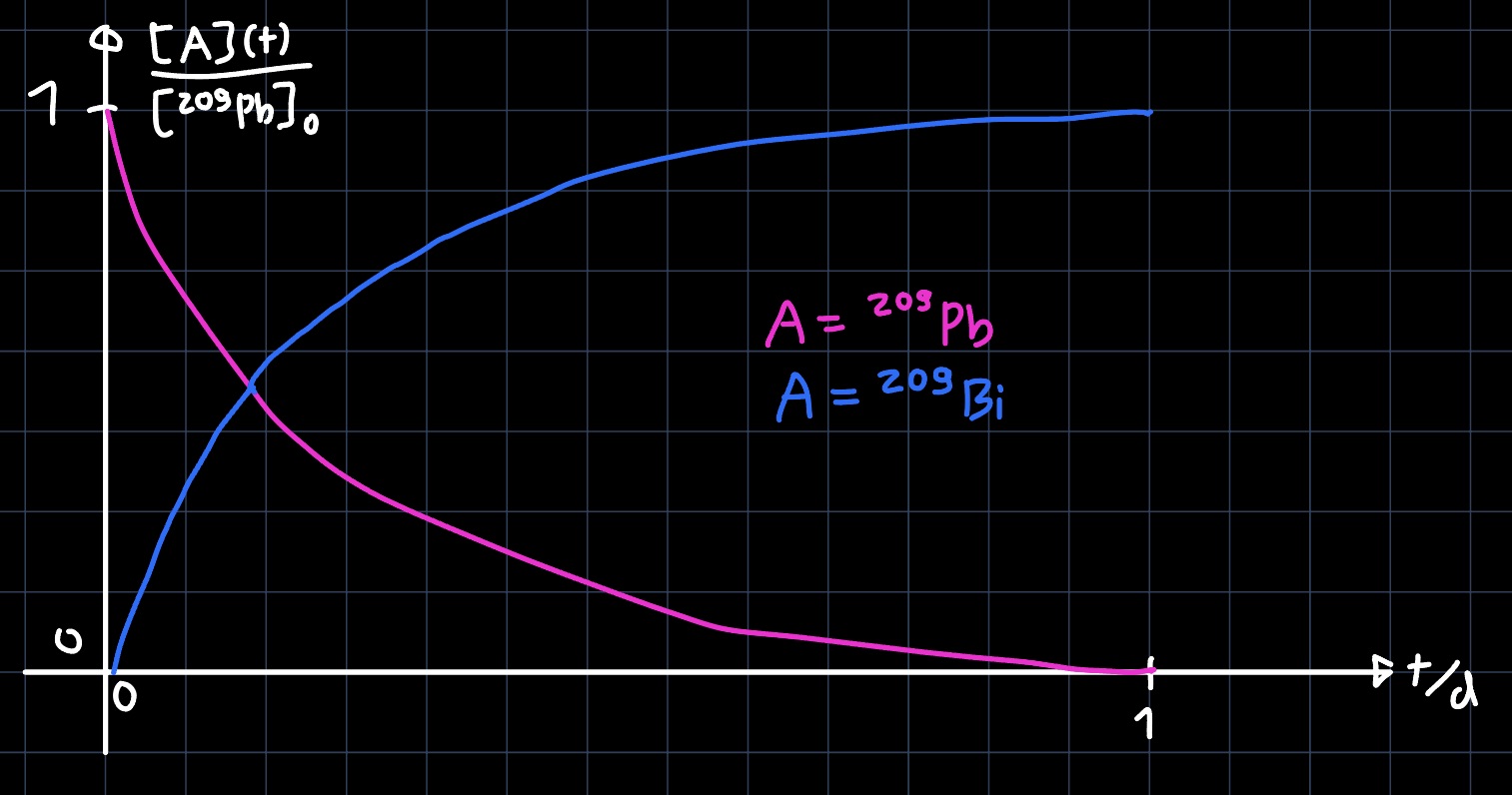
d) Draw a qualitative diagram of the number of the nuclei involved as a function of time in a time interval from $0$ to $1\, \mathrm{d}$,
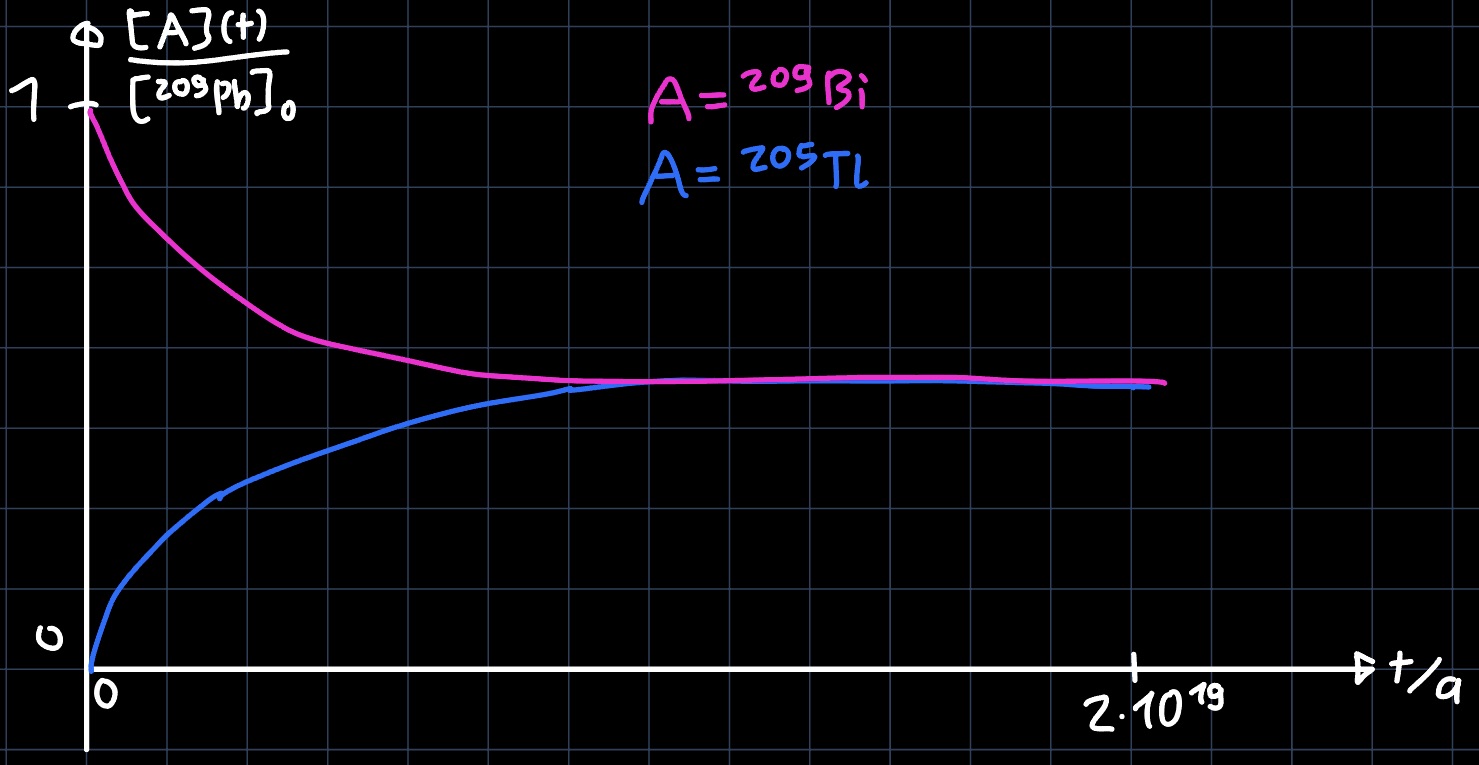
e) as well as in a time interval from $0$ to $2 \cdot 10^{19}\, \mathrm{a}$.
f) The lecture notes give a general formula for the number of nuclei as a function of time for a decay series:
$$T(1) \xrightarrow{^{k_1}} T(2) \xrightarrow{^{k_2}} \cdots \xrightarrow{^{k_N}} T(N+1)$$
$$N_{T(i)}(t) = N_{T(1)}(t=0) \prod_{n=1}^{i-1} k_n \sum_{l=1}^i \frac{\exp(-k_l(t))}{\prod_{j=1}^{l-1}(k_j-k_l) \prod_{j=l+1}^i (k_j-k_l)} $$
Use this formula to calculate the number of the first two nuclei as a function of time for the decay series of $^{209}\mathrm{Pb}$. Check whether your diagrams from d) and e) agree with this formula.
g) At what time is the number of nuclei of the unstable isotope at its maximum? How large is the fraction of the unstable isotope at that time?
Solutions
Solution decay series of $^{209}\mathrm{Pb}$
a) The decay equations we are looking for are:
$$ _{82}^{209} \mathrm{Pb} \rightarrow ^{209}_{83} \mathrm{Bi^+} + e^- + \bar{\nu_e} $$
$$ _{83}^{209} \mathrm{Bi} \rightarrow ^{205}_{81} \mathrm{Tl^{2-}} + \mathrm{He^{2+}} $$
b) We obtain the decay constants via the formula
$$ k = \frac{\ln(2)}{t_{1/2}} $$
where $t_{1/2}$ is the half-life. For $^{209}\mathrm{Pb}$ we obtain
$$ k_{^{209}\mathrm{Pb}} = \frac{\ln(2)}{3.253\, \mathrm{h}} \approx 5.919 \cdot 10^{-5}\, \mathrm{s^{-1}} $$
and for $^{209}\mathrm{Bi}$
$$ K_{^{209}\mathrm{Bi}} = \frac{\ln(2)}{2.01 \cdot 10^{19}\, \mathrm{a}} \approx 1.09 \cdot 10^{-27}\, \mathrm{s^{-1}} $$
c) The differential equations can be found from the reaction equations from a):
$$ \frac{{\rm{d}}{N_{^{209}\mathrm{Pb}}}}{{\rm{d}}t} = - k_{^{209}\mathrm{Pb}} N_{^{209}\mathrm{Pb}} $$
$$ \frac{{\rm{d}}{N_{^{209}\mathrm{Bi}}}}{{\rm{d}}t} = k_{^{209}\mathrm{Pb}} N_{^{209}\mathrm{Pb}} - k_{^{209}\mathrm{Bi}} N_{^{209}\mathrm{Bi}} $$
$$ \frac{{\rm{d}}{N_{^{205}\mathrm{Tl}}}}{{\rm{d}}t} = k_{^{209}\mathrm{Bi}} N_{^{209}\mathrm{Bi}} $$
d) Within one day, the concentration of $^{209}\mathrm{Pb}$ decreases exponentially to
$$ 2^{-\frac{24 \mathrm{h}}{3.253 \mathrm{h}}} \approx 0.006 \approx 0 $$
while the concentration of $^{209}\mathrm{Bi}$ increases exponentially to $\approx 1$. The exponential decrease of $^{209}\mathrm{Bi}$ is negligible due to its much larger half-life, which means that a negligibly small amount of $^{205}\mathrm{Tl}$ is formed. So a qualitative diagram looks like this:
e) On the much longer time scale, the half-life of $^{209}\mathrm{Pb}$ is negligible (practically everything will have decayed). So the concentration of $^{209}\mathrm{Bi}$ decreases exponentially while the concentration of $^{205}\mathrm{Tl}$ increases exponentially. So a qualitative diagram looks like this:
f) Plugging into the general formula gives:
$$N_{^{209}\mathrm{Pb}}(t) = N_{^{209}\mathrm{Pb}}(t=0) \cdot \exp(-k_{^{209}\mathrm{Pb}} t)$$
$$ \begin{aligned} N_{^{209}\mathrm{Bi}}(t) &= N_{^{209}\mathrm{Pb}}(t=0) \cdot k_{^{209}\mathrm{Pb}}\left(\frac{\exp(-k_{^{209}\mathrm{Pb}} t)}{{k_{^{209}\mathrm{Bi}} - k_{^{209}\mathrm{Pb}}}} + \frac{\exp(-k_{^{209}\mathrm{Bi}} t)}{k_{^{209}\mathrm{Pb}} - k_{^{209}\mathrm{Bi}}}\right) \\ &= N_{^{209}\mathrm{Pb}}(t=0) \cdot \frac{k_{^{209}\mathrm{Pb}}}{k_{^{209}\mathrm{Bi}} - k_{^{209}\mathrm{Pb}}}\bigg(\exp(-k_{^{209}\mathrm{Pb}} t) - \exp(-k_{^{209}\mathrm{Bi}} t)\bigg) \end{aligned} $$
This agrees with the diagrams from d) and e), since $k_{^{209}\mathrm{Pb}} \ll k_{^{209}\mathrm{Bi}}$.
g) To determine the maximum number of nuclei of the unstable isotope, we have to differentiate the differential equation for $N_{^{209}\mathrm{Bi}}$ with respect to $t$ and set it equal to zero:
$$ \begin{aligned} \frac{{\rm{d}}{N_{^{209}\mathrm{Bi}}}}{{\rm{d}}t} &= N_{^{209}\mathrm{Pb}}(t=0) \cdot \frac{k_{^{209}\mathrm{Pb}}}{k_{^{209}\mathrm{Bi}} - k_{^{209}\mathrm{Pb}}} \bigg( -k_{^{209}\mathrm{Pb}} \exp(-k_{^{209}\mathrm{Pb}} t) - -k_{^{209}\mathrm{Bi}} \exp(-k_{^{209}\mathrm{Bi}} t)\bigg) \\ & \propto k_{^{209}\mathrm{Pb}} \exp(-k_{^{209}\mathrm{Pb}} t) - k_{^{209}\mathrm{Bi}} \exp(-k_{^{209}\mathrm{Bi}} t) \end{aligned} $$
From this it follows that
$$ t = \frac{1}{k_{^{209}\mathrm{Pb}} - k_{^{209}\mathrm{Bi}}} \ln\left(\frac{k_{^{209}\mathrm{Pb}}}{k_{^{209}\mathrm{Bi}}}\right) \approx 8.84 \cdot 10^5\, \mathrm{s} $$
and
$$ N_{^{209}\mathrm{Bi}}(t = 4.00 \cdot 10^{9}\, \mathrm{s}) \approx 1.0 \cdot N_{^{209}\mathrm{Pb}}(t = 0) $$
as we already saw in e).
Week 6 - Nuclear Fission & Energy Production
Theory
We didn't really have any new theory in the lecture, but I'd like to go over an important part of last week's exercise:
d) Within one day, the concentration of $^{209}\mathrm{Pb}$ decreases exponentially to
$$ 2^{-\frac{24 \mathrm{h}}{3.253 \mathrm{h}}} \approx 0.006 \approx 0 $$
while the concentration of $^{209}\mathrm{Bi}$ increases exponentially to $\approx 1$. The exponential decrease of $^{209}\mathrm{Bi}$ is negligible due to its much larger half-life, which means that a negligibly small amount of $^{205}\mathrm{Tl}$ is formed. So a qualitative diagram looks like this:
e) On the much longer time scale, the half-life of $^{209}\mathrm{Pb}$ is negligible (practically everything will have decayed). So the concentration of $^{209}\mathrm{Bi}$ decreases exponentially while the concentration of $^{205}\mathrm{Tl}$ increases exponentially. So a qualitative diagram looks like this:
f) The lecture notes give a general formula for the number of nuclei as a function of time for a decay series:
$$T(1) \xrightarrow{^{k_1}} T(2) \xrightarrow{^{k_2}} \cdots \xrightarrow{^{k_N}} T(N+1)$$
$$N_{T(i)}(t) = N_{T(1)}(t=0) \prod_{n=1}^{i-1} k_n \sum_{l=1}^i \frac{\exp(-k_l(t))}{\prod_{j=1}^{l-1}(k_j-k_l) \prod_{j=l+1}^i (k_j-k_l)} $$
Use this formula to calculate the number of the first two nuclei as a function of time for the decay series of $^{209}\mathrm{Pb}$. Check whether your diagrams from d) and e) agree with this formula.
Plugging into the formula gives (abbreviating $k_{\mathrm{Pb}}$ as $k_1$ and $k_{\mathrm{Bi}}$ as $k_2$):
$$N_{1}(t) = N_{1}(t=0) \cdot \exp(-k_{1} t)$$
$$ \begin{aligned} N_{2}(t) &= N_{1}(t=0) \cdot k_{1}\left(\frac{\exp(-k_{1} t)}{{k_{2} - k_{1}}} + \frac{\exp(-k_{2} t)}{k_{1} - k_{2}}\right) \\ &= N_{1}(t=0) \cdot \frac{k_{1}}{k_{2} - k_{1}}\bigg(\exp(-k_{1} t) - \exp(-k_{2} t)\bigg) \end{aligned} $$
We see the agreement with the diagram from e), since the time is very large compared to the decay constant of $\mathrm{^{209}Pb}$, and thus the term for the number of $\mathrm{^{209}Pb}$ nuclei is negligibly small. The number of $\mathrm{^{209}Bi}$ decreases exponentially during the time shown.
g) At what time is the number of nuclei of the unstable isotope at its maximum? How large is the fraction of the unstable isotope at that time?
To determine the maximum number of nuclei of the unstable isotope, we have to differentiate the differential equation for $N_{2}$ with respect to $t$ and set it equal to zero:
$$ \begin{aligned} \frac{{\rm{d}}{N_{2}}}{{\rm{d}}t} &= N_{1}(t=0) \cdot \frac{k_{1}}{k_{2} - k_{1}} \bigg( -k_{1} \exp(-k_{1} t) - -k_{2} \exp(-k_{2} t)\bigg) \\ & \propto k_{1} \exp(-k_{1} t) - k_{2} \exp(-k_{2} t) \end{aligned} $$
From this it follows that
$$ t = \frac{1}{k_{1} - k_{2}} \ln\left(\frac{k_{1}}{k_{2}}\right) \approx 8.84 \cdot 10^5\, \mathrm{s} $$
and
$$ N_{^{209}\mathrm{Bi}}(t = 4.00 \cdot 10^{9}\, \mathrm{s}) \approx 1.0 \cdot N_{^{209}\mathrm{Pb}}(t = 0) $$
as we already saw in e).
Exercises
Gösgen-Däniken nuclear power plant
In conventional nuclear power plants, energy is obtained from the nuclear fission of uranium. The isotope $\mathrm{^{235}U}$ is split by a neutron into $\mathrm{^{89}Kr}$ and $\mathrm{^{144}Ba}$, releasing three additional neutrons. The masses of the atoms involved are:
$${m}\left( {_{{\mathrm{92}}}^{{\mathrm{235}}}{\mathrm{U}}} \right) = 235.04392996\, \mathrm{u}$$
$${m}\left( {_{\mathrm{0}}^{\mathrm{1}}{\mathrm{n}}} \right) = 1.00866492\, \mathrm{u}$$
$${m}\left( {_{{\mathrm{56}}}^{{\mathrm{144}}}{\mathrm{Ba}}} \right) = 143.92295281\, \mathrm{u}$$
$${m}\left( {_{{\mathrm{36}}}^{{\mathrm{89}}}{\mathrm{Kr}}} \right) = 88.91763058\, \mathrm{u}$$
a) Set up a reaction equation for the described nuclear fission of $\mathrm{^{235}U}$. (Read carefully!)
b) Calculate the energy (in $\mathrm{kJ/mol})$ released in the reaction.
c) Since natural uranium consists of only $0.7\%$ $\mathrm{^{235}U}$, the uranium has to be enriched before use. Enriched uranium consists of $3.5\%$ $\mathrm{^{235}U}$ and $96.5\%$ $\mathrm{^{238}U}.$ Calculate the energy released by nuclear fission per $\mathrm{kg}$ of enriched uranium.
d) The Gösgen-Däniken nuclear power plant produces electricity with a power of around $1.0\, \mathrm{GW}$ [^1]. How much enriched uranium $(\text{in} \, \mathrm{kg})$ has to be delivered daily for this?
e) In reality, about $50\, \mathrm{kg}$ of enriched uranium is used per day (according to the plant itself [^2]). Where does the difference to your result from d) come from?
f) Now consider a coal power plant in which coal $(\mathrm{C})$ is converted to $\mathrm{CO_2}$. Give a reaction equation for the combustion of coal.
g) The standard enthalpy of formation of $\mathrm{CO_2}$ is $\Delta H_B = -393\, \mathrm{kJ/mol}.$ How much coal has to be burned to produce the same amount of energy as is produced in d) in one day? (in mol) Assume that the coal power plant has an efficiency of $45 \%$ (high for coal power plants) [^3].
h) So how much $\mathrm{CO_2}$ emission is saved daily by operating the Gösgen-Däniken nuclear power plant? (in kg)
Coal naturally also contains radioactive substances, more precisely about $1\, \mathrm{ppm} \, ^{238}_{92}\mathrm{U}$ and $2\, \mathrm{ppm} \, ^{232}_{90}\mathrm{Th}$ [^4].
i) Calculate the activity of the radioactive substances in the coal burned in one day. (in $\mathrm{Bq}$) Use the half-lives $t_{1/2}(^{238}\mathrm{U}) = 4.5 \cdot 10^9 \, \mathrm{a}$ and $t_{1/2}(^{232}\mathrm{Th}) = 1.4 \cdot 10^{10} \, \mathrm{a}.$
j) Assume the radioactive substances stay behind in the ash and don't reach the atmosphere with the flue gas. Why is the radiation exposure from coal unproblematic, while the radiation exposure from the remaining ash is a problem?
The big problem with radiation exposure from coal power plants, however, is that the ash is not treated as a pollutant, but is often stored unprotected in landfills [^5]. As a result, the radioactive substances are released into the environment and lead to additional radiation exposure. Radiation exposure is given by the effective dose $D$, which is measured in $\mathrm{mSv}$. The effective dose is a measure of the biological effect of the radiation. The effective dose can be calculated using the formulas:
$$D_{uran} = 1.53 \cdot 10^{-12} \, \frac{\mathrm{mSv/h}}{\mathrm{Bq/cm^3}} \frac{A}{V}$$
$$D_{thorium} = 2.06 \cdot 10^{-11} \, \frac{\mathrm{mSv/h}}{\mathrm{Bq/cm^3}} \frac{A}{V}$$
and is additive. Here $A/V$ is the concentration of the respective substance.
k) Assume that $100\%$ of the radioactive substances in the ash (reasonable, since it is an equilibrium state) are released into a surrounding area of $1\, \mathrm{km^3}$. Calculate the additional radiation exposure in $\mathrm{mSv/a}$ for the surroundings. According to its own information, the Leibstadt nuclear power plant causes a radiation exposure of at most $0.01\, \mathrm{mSv/a}$ and produces a similar amount of electricity as the Gösgen-Däniken nuclear power plant considered above [^6]. So does a nuclear power plant or a coal power plant cause more radiation exposure?
Solutions
Solution Gösgen-Däniken nuclear power plant
a) The reaction equation we are looking for is:
$$\mathrm{^{235}U} + \mathrm{_0^1 n} \rightarrow \mathrm{^{89}Kr} + \mathrm{^{144}Ba} + 3\, \mathrm{_0^1 n}$$
b) First we calculate the mass difference:
$$\Delta m = m\left( ^{{\mathrm{235}}}{\mathrm{U}} \right) - m\left( ^{{\mathrm{89}}}{\mathrm{Kr}} \right) - m\left( ^{{\mathrm{144}}}{\mathrm{Ba}} \right) - 2 m\left( ^{\mathrm{1}}{\mathrm{n}} \right) \approx 0.186\, \mathrm{u}$$
Einstein's formula then gives us the energy:
$$\Delta E = \Delta m c^2 \approx 2.78 \cdot 10^{-11}\, \mathrm{J}$$
And converted to $\mathrm{kJ/mol}$:
$$\Delta E \approx 1.67 \cdot 10^{10} \, \mathrm{kJ/mol}$$
c) We have already calculated the energy per mole. To get the energy per $\mathrm{kg}$, we have to divide by the molar mass:
$$\Delta E = \frac{120\, \mathrm{kJ/mol}}{235.04\dots \, \mathrm{g/mol}} = 7.11 \cdot 10^{13}\, \mathrm{J/kg}$$
Now we still have to take into account the fraction of fissile $\mathrm{^{235}U}$ in enriched uranium:
$$\Delta E = 7.11 \cdot 10^{10}\, \mathrm{kJ/g} \cdot 0.035 = 2.49 \cdot 10^{12} \, \mathrm{J/kg}$$
d) A power of $1.0\, \mathrm{GW}$ means that $1.0\, \mathrm{GJ}$ of energy is produced per second. We can now use the energy per kilogram from c) to calculate the mass of uranium:
$$m_{\mathrm{U, theoretical}} = \frac{1.0\, \mathrm{GW}}{2.49 \cdot 10^{12}\, \mathrm{J/kg}} \frac{86400 \mathrm{s}}{\mathrm{d}} \approx 34.7\, \mathrm{kg/d}$$
e) The difference comes from the fact that the power plant doesn't have an efficiency of $100\%$. By comparing the numbers, we can even estimate the efficiency of the power plant:
$$\eta = \frac{m_{\mathrm{U, theoretical}}}{m_{\mathrm{U, real}}} \approx 63\%$$
f)
$$\mathrm{C} + \mathrm{O_2} \rightarrow \mathrm{CO_2}$$
g) In one day,
$$E = 1.0\, \mathrm{GW} \cdot 86400\, \mathrm{s/d} \approx 8.6 \cdot 10^{13}\, \mathrm{J/d}$$
is produced. For this we need
$$n_{\mathrm{C}} = -\frac{E}{\Delta H_B} \cdot \frac{1}{0.45} \approx 4.89 \cdot 10^8 \, \mathrm{mol}$$
h) Since the reaction is stoichiometric, one mole of $\mathrm{CO_2}$ is produced per mole of $\mathrm{C}$. This gives:
$$m_{\mathrm{CO_2}} = n_{\mathrm{C}} \cdot M_{\mathrm{CO_2}} \approx 2.15 \cdot 10^7 \, \mathrm{kg}$$
So a considerable amount that is saved every day by operating the nuclear power plant!
i) From the half-lives we obtain the decay constants:
$$k_{\mathrm{U}} = \frac{\ln(2)}{t_{1/2}(\mathrm{U})} \approx 1.5 \cdot 10^{-10} \, \mathrm{a^{-1}} \approx 4.9 \cdot 10^{-18} \, \mathrm{s^{-1}}$$
$$k_{\mathrm{Th}} = \frac{\ln(2)}{t_{1/2}(\mathrm{Th})} \approx 5.0 \cdot 10^{-11} \, \mathrm{a^{-1}} \approx 1.6 \cdot 10^{-18} \, \mathrm{s^{-1}}$$
Then we need the number of atoms of the radioactive substances in the coal:
$$N_{\mathrm{U}} = 1 \cdot 10^{-6} \cdot 4.89 \cdot 10^8 \mathrm{mol} \cdot 6.022 \cdot 10^{23} \mathrm{atoms/mol} \approx 2.9 \cdot 10^{26} \, \mathrm{atoms}$$
$$N_{\mathrm{Th}} = 2 \cdot 10^{-6} \cdot 4.89 \cdot 10^8 \mathrm{mol} \cdot 6.022 \cdot 10^{23} \mathrm{atoms/mol}\approx 5.8 \cdot 10^{26} \, \mathrm{atoms}$$
The activity is then:
$$A_{\mathrm{U}} = k_{\mathrm{U}} N_{\mathrm{U}} \approx 1.4 \cdot 10^{9} \, \mathrm{Bq}$$
$$A_{\mathrm{Th}} = k_{\mathrm{Th}} N_{\mathrm{Th}} \approx 9.1 \cdot 10^{8} \, \mathrm{Bq}$$
Finally, the activity is obtained by adding the activities of the two radioactive substances:
$$A_{ges} = A_{\mathrm{U}} + A_{\mathrm{Th}} \approx 2.3 \cdot 10^{9} \, \mathrm{Bq}$$
j) Before, the concentration was extremely low; after all, there were only $1$ to $2$ atoms per million atoms of coal. Now the concentration is extremely high, since the carbon atoms have escaped into the atmosphere as $\mathrm{CO_2}$ and only the impurities are left behind.
$$D_{uran} = 1.53 \cdot 10^{-12} \, \frac{\mathrm{mSv/h}}{\mathrm{Bq/cm^3}} \frac{A}{V}$$
$$D_{thorium} = 2.06 \cdot 10^{-11} \, \frac{\mathrm{mSv/h}}{\mathrm{Bq/cm^3}} \frac{A}{V}$$
and is additive. Here $A/V$ is the concentration of the respective substance.
k) Assume that $100\%$ of the radioactive substances in the ash (reasonable, since it is an equilibrium state) are released into a surrounding area of $1\, \mathrm{km^3}$. Calculate the additional radiation exposure in $\mathrm{mSv/a}$ for the surroundings. According to its own information, the Leibstadt nuclear power plant causes a radiation exposure of at most $0.01\, \mathrm{mSv/a}$ and produces a similar amount of electricity as the Gösgen-Däniken nuclear power plant considered above [^6]. So does a nuclear power plant or a coal power plant cause more radiation exposure?
We can directly use the given formulas:
$$D_{\mathrm{U}} = 1.53 \cdot 10^{-12} \frac{\mathrm{mSv/h}}{\mathrm{Bq/cm^3}} \frac{1.4 \cdot 10^9 \, \mathrm{Bq}}{1 \, \mathrm{km^3}} \approx 1.9 \cdot 10^{-14} \, \mathrm{mSv/h}$$
$$D_{\mathrm{Th}} = 2.06 \cdot 10^{-11} \frac{\mathrm{mSv/h}}{\mathrm{Bq/cm^3}} \frac{9.1 \cdot 10^8 \, \mathrm{Bq}}{1 \, \mathrm{km^3}} \approx 1.7 \cdot 10^{-13} \, \mathrm{mSv/h}$$
Together this gives:
$$D_{\mathrm{ges}} = D_{\mathrm{U}} + D_{\mathrm{Th}} \approx 1.9 \cdot 10^{-5} \, \mathrm{mSv/a}$$
This is significantly less than the radiation exposure from the Leibstadt nuclear power plant. So a nuclear power plant causes more radiation exposure than a coal power plant; however, we haven't taken into account many other pollutants that are released into the environment by operating a coal power plant.
Sources
[^1] Gösgen-Däniken NPP electricity production
[^2] Gösgen-Däniken NPP uranium consumption
[^3] Efficiency of coal power plants
Week 7 - Derivatives, Integrals & Differential Equations
Theory
Derivatives
The derivative of a function $f(x)$ at the point $x_0$ is defined as
$$ f'(x_0) = \dd{f}{x} = \lim_{h \to 0} \frac{f(x_0 + h) - f(x_0)}{h} $$
So the function $f'(x)$ gives the local slope of the function $f(x)$ at every point $x$. Now we can continue and ask ourselves what the slope of $f'(x)$ is. This is described by the second derivative $f''(x)$. So the second derivative is the slope of the slope of $f(x)$.
Differentiation rules
In this lecture we are interested in applying the derivative; the definition isn't that important for us. So we'll mainly deal with the differentiation rules so that we can calculate with them well. The most important ones are (for $a, n, \delta$ and $c$ arbitrary constants (numbers)):
$$\text{Derivative of a constant: } \dd{}{x} c = 0$$
$$\text{Derivative of a polynomial: } \dd{}{x} (ax^n) = nax^{n-1}$$
$$\text{Derivative of the exponential function: } \dd{}{x} \exp(ax) = a\exp(ax)$$
$$\text{Derivative of the sine function: } \dd{}{x} \sin{(ax + \delta)} = a\cos{(ax + \delta)}$$
$$\text{Derivative of the cosine function: } \dd{}{x} \cos{(ax + \delta)} = -a\sin{(ax + \delta)}$$
$$\text{Derivative of the logarithm function: } \dd{}{x} \ln{(ax + \delta)} = \frac{1}{ax + \delta}$$
The derivative is linear. This means that the derivative of a sum of functions is equal to the sum of the derivatives of the summands. With the product of two functions it's not that simple; but we'll deal with that next time.
Integrals
The inverse of the derivative is called the integral. The integral of a function $f(x)$ from $a$ to $b$ is defined as
$$ \int_a^b f(x) \mathrm{d}x = \lim_{n \to \infty} \sum_{i=1}^n f(x_i) \Delta x_i $$
where $\Delta x_i = \frac{b-a}{n}$ and $x_i = a + i \Delta x_i$.
As the inverse of the derivative, integration is also linear. This means that the integral of a sum of functions is equal to the sum of the integrals of the summands.
Integration rules
This definition isn't important for us; we'll mainly deal with the rules for integrating. The most important ones are (for $a$ and $c$ arbitrary constants (numbers) and $n \neq -1$):
$$\text{Integral of a constant: } \int c \mathrm{d}x = cx + C$$
$$\text{Integral of a polynomial: } \int ax^n \mathrm{d}x = \frac{1}{n+1}ax^{n+1} + C$$
$$\text{Special case: } \int \frac{1}{x} \mathrm{d}x = \ln{|x|} + C$$
$$\text{Integral of the exponential function: } \int \exp(ax) \mathrm{d}x = \frac{1}{a}\exp(ax) + C$$
$$\text{Integral of the sine function: } \int \sin{(ax + \delta)} \mathrm{d}x = -\frac{1}{a}\cos{(ax + \delta)} + C$$
$$\text{Integral of the cosine function: } \int \cos{(ax + \delta)} \mathrm{d}x = \frac{1}{a}\sin{(ax + \delta)} + C$$
where $C$ is an arbitrary constant, since it vanishes when differentiating.
Differential equations
Differential equations are equations in which the variable we're looking for is no longer simply a number; instead we want to find a function that satisfies the equations for all values of the independent variable (for $f(x)$, $x$ is called the independent variable). An example of a (simple) differential equation is
$$ \dd{f}{x} = f $$
We can recognize the solution of this DE right away from the differentiation rule for the exponential function:
$$ \dd{}{x} \exp(x) = \exp(x) $$
So the solution is $f(x) = \exp(x)$. In this lecture you basically don't have to solve differential equations yourself. However, you should be able to check whether a given ansatz satisfies a differential equation or not.
Exercises
Simple derivatives
Here are a few simple derivatives to get a feel for it. So that you can check right away whether your solution is correct, these are already unlocked. Calculate the derivative of the following functions:
$$f(x) = 3x^2$$
$$g(x) = 2x^3 + 3x^2$$
$$h(x) = 2x^3 + 3x^2 + 4x + 5$$
$$i(x) = \sin(x) + \cos(2x)$$
$$j(x) = \exp(5x) + \sin(x) + \cos(2x)$$
$$k(x) = \exp(8x) + \sin(0.1 x) + \cos(2x) + 3x^2$$
Simple integrals
The same with a few simple integrals. Find the functions whose derivatives are the following functions:
$$l'(x) = 6x$$
$$m'(x) = 5x^2 + 2x^4$$
$$n'(x) = \exp(x) + \cos(2x)$$
$$o'(x) = \sin(x) + 22x^{22}$$
$$p'(x) = \exp(5x) + \sin(x) + \cos(2x)$$
Simple differential equations
Here are a few simple differential equations. Find the solution for each:
$$\dd{f}{x} = 5 f(x)$$
$$\dd{f}{x} = -2 f(x) + 3$$
$$\dd{^2 f}{x^2} = -f(x)$$
This is roughly the level at which you'll be able to solve differential equations in this lecture. It's more about checking given ansätze. This takes some practice, but basically you only have to apply the differentiation rules and substitute. However, we don't know enough differentiation rules yet to be able to solve all differential equations. That comes next time.
Solutions
Solutions simple derivatives
$$f'(x) = 6x$$
$$g'(x) = 6x^2 + 6x$$
$$h'(x) = 6x^2 + 6x + 4$$
$$i'(x) = \cos(x) - 2\sin(2x)$$
$$j'(x) = 5\exp(5x) + \cos(x) - 2\sin(2x)$$
$$k'(x) = 8\exp(8x) + 0.1\cos(0.1 x) - 2\sin(2x) + 6x$$
Solutions simple integrals
$$l(x) = 3x^2 + C$$
$$m(x) = \frac{5}{3}x^3 + \frac{2}{5}x^5 + C$$
$$n(x) = \exp(x) + \frac{1}{2}\sin(2x) + C$$
$$o(x) = -\cos(x) + \frac{22}{23}x^{23} + C$$
$$p(x) = \frac{1}{5}\exp(5x) - \cos(x) + \frac{1}{2}\sin(2x) + C$$
Solutions simple differential equations
For $A, B$ arbitrary constants:
$$f(x) = A \exp(5x)$$
$$f(x) = A \exp(-2x) + 1.5$$
$$f(x) = A \sin(x) + B cos(x)$$
Week 8 - Partial Derivatives, Wave Equation & Line Spectra
Theory
Review of differentiation rules
Last week we looked at the simple differentiation rules. Here they are again as a reminder (for $a, n$ and $c$ arbitrary constants (numbers)):
$$\text{Derivative of a constant: } \dd{}{x} c = 0$$
$$\text{Derivative of a polynomial: } \dd{}{x} (ax^n) = nax^{n-1}$$
$$\text{Derivative of the exponential function: } \dd{}{x} \exp(ax) = a\exp(ax)$$
$$\text{Derivative of the sine function: } \dd{}{x} \sin{(ax + \delta)} = a\cos{(ax + \delta)}$$
$$\text{Derivative of the cosine function: } \dd{}{x} \cos{(ax + \delta)} = -a\sin{(ax + \delta)}$$
$$\text{Derivative of the logarithm function: } \dd{}{x} \ln{(ax + \delta)} = \frac{1}{ax + \delta}$$
Today we'll look at how to calculate the derivative of composite and multiplied functions.
Derivative of products of functions
If we consider the product of two functions $f(x) = g(x) \cdot h(x)$, we need the product rule:
$$ \dd{f}{x} = \dd{g}{x} h + g \dd{h}{x} $$
Let's consider $f(x) = x^2 \cdot x^4$ as a simple example to see that it is consistent with the derivative of polynomials:
$$ \dd{f}{x} = \dd{x^2}{x} x^4 + x^2 \dd{x^4}{x} = 2x \cdot x^4 + x^2 \cdot 4x^3 = 2x^5 + 4x^5 = 6x^5 $$
We get the same result if we first multiply out the function to $f(x) = x^2 \cdot x^4 = x^6$ and then take its derivative, $\dd{f}{x} = 6x^5$.
So that you don't think the rule is superfluous, here's another example where it's really needed:
$$ f(x) = \sin{(x)} \cdot \cos{(x)} $$
Here $g(x) = \sin{(x)}$ and $h(x) = \cos{(x)}$. The derivative is:
$$ \dd{f}{x} = \dd{g}{x} h + g \dd{h}{x} = \cos{(x)} \cdot \cos{(x)} + \sin{(x)} \cdot (-\sin{(x)}) = \cos^2{(x)} - \sin^2{(x)} $$
Composite functions
A composite function is a function that is made up of several functions and is written as $f(g(x))$. The rule then states that the derivative is given by:
$$ \dd{f}{x} = \dd{f}{g} \dd{g}{x} $$
Here, too, let's look at an example we already know, $f(x) = \exp{(5x)}$, to see that the rule is consistent with the rules we've used so far. Here $f(g) = \exp(g)$ and $g(x) = 5x$. The derivative is:
$$ \dd{f}{x} = \dd{f}{g} \dd{g}{x} = \exp(g(x)) \cdot 5 = 5 \exp{(5x)} $$
Let's look at a somewhat harder example:
$$ f(x) = \sin{(x^2 + 1)} $$
With the notation $f(g(x))$, $f(g) = \sin(g)$ and $g(x) = x^2 + 1$. Its derivative is:
$$ \dd{f}{x} = \dd{f}{g} \dd{g}{x} = \cos{(x^2 + 1)} \cdot 2x $$
This rule can also be applied to compositions of more than two functions. Consider for example
$$ f(x) = \sin{(\exp{(x^2 + 1)})} $$
With the notation $f(g(h(x)))$, $f(g) = \sin(g)$ and $g(h) = \exp(h)$ and $h(x) = x^2 + 1$. Its derivative is:
$$ \dd{f}{x} = \dd{f}{g} \dd{g}{h} \dd{h}{x} = \cos{(\exp{(x^2 + 1)})} \cdot \exp{(x^2 + 1)} \cdot 2x $$
The rule applied here is called the chain rule, and you'll get to know it in more detail in Analysis. Here you just need to be able to apply it.
Partial derivatives
Last week we looked at the derivative for functions with only one independent variable. In physics/physical chemistry, however, we often deal with functions that depend on several variables. For example, if we consider a potential $V$ in three-dimensional space, it is a function of the three position variables $x, y$ and $z$:
$$ V = V(x, y, z) $$
We can now ask ourselves what the slope of the function at a specific point $(x_0, y_0, z_0)$ is. The slope is defined as the change of the function per change of the independent variable. Since we have several independent variables here, we have to decide which one we want to change. For example, we can calculate the slope in the $x$-direction by evaluating the function at the point $(x_0 + \Delta x, y_0, z_0)$ and then dividing the change by $\Delta x$:
$$ \text{Slope in } x \text{-direction: } \frac{V(x_0 + \Delta x, y_0, z_0) - V(x_0, y_0, z_0)}{\Delta x} $$
But this is exactly the definition of the derivative if we let $\Delta x$ go to zero and treat $y, z$ as constants. This is called the partial derivative with respect to $x$ and is written as:
$$ \frac{\partial V}{\partial x} $$
Analogously, we obtain the partial derivatives with respect to $y$ and $z$ by treating the other two variables as constant and differentiating the function with respect to $y$ or $z$:
$$ \frac{\partial V}{\partial y} \text{ and } \frac{\partial V}{\partial z} $$
If we have a differential equation with functions of several variables in which the partial derivative appears, it is called a partial differential equation. You don't need to be able to solve these, but you should be able to check whether a given function satisfies one.
The wave equation
The wave equation is a partial differential equation that describes the propagation of waves. It reads:
$$ \frac{\partial^2 \psi}{\partial x^2} = \frac{1}{v^2} \frac{\partial^2 \psi}{\partial t^2} $$
Here $\psi$ is the wave function, $x$ the position variable and $t$ the time variable. $v$ is the propagation speed of the wave, e.g. for light the speed of light $c$. The wave equation is one of the most important equations in physics and is used in quantum mechanics to describe the wave function of particles. For now, the point is to learn how to handle it mathematically. You'll get to know it in more detail in the exercises and in the lecture.
Photons and their energy
As an introduction to quantum mechanics, we consider light, i.e. electromagnetic waves. These can be regarded as particles, the photons. The energy of a photon is given by
$$ E = h \nu = h \frac{c}{\lambda} $$
where $h$ is Planck's constant, $\nu$ the frequency, $c$ the speed of light and $\lambda$ the wavelength. Here we have also used the relation between frequency and wavelength:
$$ \nu = \frac{c}{\lambda} $$
Spectroscopy and line spectra
In quantum mechanics, electrons can only be found at certain energy levels (= shells) in an atom. The energy level/shell an electron is in can be changed if energy is added to the electron by a photon. So if monochromatic light (only one wavelength, no mixture) is sent in the $x\mathrm{-direction}$ through a container filled with hydrogen and a detector is placed in the $y\mathrm{-direction}$, only certain wavelengths are detected. For better understanding, here's an animation of the Balmer series (transitions in the hydrogen atom that lie in the visible range):
Balmer series: absorption of visible light by exciting an electron from the second to the third (red) or fourth (cyan) shell. The other wavelengths are not absorbed and simply pass through.
More generally, for the transition from state $n_1$ to state $n_2$ in the hydrogen atom we have the formula:
$$ E = h \nu = h c R_H \cdot \mathrm{abs}\bigg( \frac{1}{n_1^2} - \frac{1}{n_2^2} \bigg) $$
From this formula we can see:
$$ \dd{}{n} \bigg( \frac{1}{n^2} \bigg) = - \frac{2}{n^3} $$
So the energy levels get closer and closer together! Furthermore, it follows from $n \in \mathbb{N}$ that there is a maximum energy that can be released when an electron is captured. This energy is called the ionization energy. If the ionization energy is supplied to an electron, it is knocked out of the atom. The ionization energy of the hydrogen atom is $E_\mathrm{ion} = 13.6\mathrm{eV}.$
Exercises
Derivatives
Determine the derivatives of the following functions:
- $f(x) = 3x^2 + 2x + 1$
- $g(x) = \exp{(x^3)}$
- $h(x) = 2x^2 \sin{(x^5)}$
- $i(x) = \sin{(\exp{(3x+5)})}$
- $j(x) = 5x + \exp{(\sin{(x)})} \cos{(x)}$
Partial derivatives
Determine the partial derivatives of the following functions (with respect to $x$ and $y$):
- $f(x, y) = 3x^2 + 2xy + y^2$
- $g(x, y) = x \exp{(x^2+y^2)}$
- $h(x, y) = \sin{(x^2+y^2)} \log{(x^2)}$
Partial differential equations
Show that the following functions, given the wave equation
$$ \frac{\partial^2 \psi}{\partial x^2} = \frac{1}{v^2} \frac{\partial^2 \psi}{\partial t^2} $$
do not satisfy it:
- $\psi_1(x,t) = x^2 t$
- $\psi_2(x,t) = \sin{(x)} \cos{(t)}$
- $\psi_3(x,t) = x \sin{(x + vt)}$
Show that the following function satisfies the wave equation:
$$ \psi_4(x,t) = A \sin{(x + vt)} + B \cos{(x+vt)} $$
Unit convention
In spectroscopy it is common to give energy in wavenumbers. The wavenumber is defined as:
$$ \tilde{\nu} = \frac{1}{\lambda} $$
where $\lambda$ is the wavelength. The unit of the wavenumber is $\mathrm{cm}^{-1}$. The conversion from wavenumber to energy is given by:
$$ E = h c \tilde{\nu} $$
where $h$ is Planck's constant and $c$ the speed of light. The unit of energy is $\mathrm{J}$.
- Calculate the energy in $\mathrm{J}$ corresponding to the wavenumber $\tilde{\nu} = 1000\, \mathrm{cm}^{-1}$.
- Calculate the wavenumber in $\mathrm{cm}^{-1}$ corresponding to the energy $E = 3\, \mathrm{eV}$.
Introduction to spectroscopy
Consider the transition in a hydrogen atom from the shell $n=7$ to the shell $n=2$.
- Is energy released or absorbed in the process?
- What energy is required/released for this transition?
- What wavelength does the emitted/absorbed light have?
Spectroscopy continued
We have learned about the Rydberg formula to calculate the energy of transitions in the hydrogen atom. It can easily be generalized to hydrogen-like atoms (atoms with only one electron, but any nuclear charge number) and then reads:
$$ E = h c Z^2 R_K \cdot \mathrm{abs}\bigg( \frac{1}{n_1^2} - \frac{1}{n_2^2} \bigg) $$
where $Z$ is the nuclear charge number and $R_K$ the Rydberg constant. For hydrogen, $Z=1$ and $R_K = R_H$. For a nucleus of mass $m_K$ and an electron of mass $m_e$, the Rydberg constant is given by:
$$ R_K = \frac{m_K}{m_K + m_e} R_{\infty} $$
- Calculate the Rydberg constant for the $^{23}\mathrm{Na}^{10+}$ ion.
- Calculate the energy of the transition $n_1 = 3 \rightarrow n_2 = 2$ in the $^{23}\mathrm{Na}^{10+}$ ion.
- Calculate the wavelength of the emitted/absorbed light for the transition in 2.
- What is the ionization energy of the $^{23}\mathrm{Na}^{10+}$ ion?
- We consider two consecutive transitions in the $^{23}\mathrm{Na}^{10+}$ ion, from $n_i$ to $n_f$ and from $n_i$ to $n_f + 1.$. The energies of the transitions are $E_{n_i \rightarrow n_f} = 123.4\mathrm{eV}$ and $E_{n_i \rightarrow n_f + 1} = 129.9\mathrm{eV}$. Determine $n_i \text{ and } n_f.$
Hint: To simplify, use the formula
$$ \frac{1}{n^2} - \frac{1}{(n+1)^2} \approx \frac{2}{(n+\frac{1}{2})^{3}} $$
Solutions
Solution derivatives
- $f'(x) = 6x + 2$
- $g'(x) = 3x^2 \exp{(x^3)}$
- $h'(x) = 4x \sin{(x^5)} + 10x^6 \cos{(x^5)}$
- $i'(x) = 3 \exp{(3x+5)} \cos{(\exp{(3x+5)})}$
- $j'(x) = 5 - \exp{(\sin{(x)})} \sin{(x)} + \exp{(\sin{(x)})} \cos{(x)} \cos{(x)}$
Solution partial derivatives
- $\frac{\partial f}{\partial x} = 6x + 2y$ and $\frac{\partial f}{\partial y} = 2x + 2y$, $\frac{\partial f}{\partial y} = 2x + 2y$
- $\frac{\partial g}{\partial x} = \exp{(x^2+y^2)} + 2x^2 \exp{(x^2+y^2)}$ and $\frac{\partial g}{\partial y} = 2xy \exp{(x^2+y^2)}$
- $\frac{\partial h}{\partial x} = 2x \cos{(x^2+y^2)} \log{(x^2)} + \frac{2x}{\partial x^2}$ and $\frac{\partial h}{\partial y} = 2y \cos{(x^2+y^2)} \log{(x^2)}$
Solution partial differential equations
- $\frac{\partial^2 \psi_1}{\partial x^2 t} = 2 t$ and $\frac{\partial^2 \psi_1}{\partial t^2} = 0$, which cannot be equal.
- $\frac{\partial^2 \psi_2}{\partial x^2} = -\sin{(x)} \cos{(t)}$ and $\frac{\partial^2 \psi_2}{\partial t^2} = -\sin{(x)} \cos{(t)}$, which are equal, but the factor $1/v^2$ is missing.
- $\frac{\partial^2 \psi_3}{\partial x^2} = 2 \cos{(x+vt)} - x \sin{(x+vt)}$ and $\frac{\partial^2 \psi_3}{\partial t^2} = -v^2 \sin{(x + vt)}$, which cannot be equal e.g. for $x = -vt$ (right-hand side is $0$, left-hand side is $2$).
The partial derivatives of $\psi_4(x,t)$ are:
$$ \begin{aligned} \frac{\partial^2 \psi_4}{\partial x^2} &= -A \sin{(x + vt)} - B \cos{(x+vt)} \\ \frac{\partial^2 \psi_4}{\partial t^2} &= -A v^2 \sin{(x + vt)} - B v^2 \cos{(x + vt)} \end{aligned}$$
which gives us exactly the required ratio of $1/v^2$.
Solution unit convention
- $E \approx 1.986 \cdot 10^{-20}\, \mathrm{J}$
- $\tilde{\nu} \approx 2.4 \cdot 10^4\, \mathrm{cm}^{-1}$
Solution introduction to spectroscopy
- Energy is released, since $n_1 > n_2$, i.e. the electron moves to a lower-energy level.
- We apply the Rydberg formula:
$$ \begin{aligned}E &= h c R_H \cdot \mathrm{abs}\bigg( \frac{1}{n_1^2} - \frac{1}{n_2^2} \bigg) \\ &= 13.6\mathrm{eV} \cdot \mathrm{abs}\bigg( \frac{1}{7^2} - \frac{1}{2^2} \bigg) \approx 3.12\, \mathrm{eV} \end{aligned} $$
- With $E = \frac{h c}{\lambda}$ we obtain $\lambda = \frac{h c}{E} \approx 397\, \mathrm{nm}$
Solution spectroscopy continued
- $ R_{Na} = \frac{m_{Na}}{m_{Na} + m_e} R_{\infty} \approx 1.097 \cdot 10^5\, \mathrm{cm}^{-1} $
- In the transition $n_1 = 3 \rightarrow n_2 = 2$, energy is released. We calculate the energy with the Rydberg formula:
$$ \Delta E = h c Z^2 R_{Na} \cdot \mathrm{abs}\bigg( \frac{1}{3^2} - \frac{1}{2^2} \bigg) \approx 189\, \mathrm{eV} $$
- $\lambda = \frac{h c}{\Delta E} \approx 656\, \mathrm{nm}$
- The ionization energy is the energy required for the transition $n_1 = 1 \rightarrow n_2 = \infty$. We can see from the Rydberg formula that this energy is $R_{Na} \approx 1.097 \cdot 10^5\, \mathrm{cm}^{-1} \equiv 1360.5\, \mathrm{eV}$.
- Since we know the energies of the two transitions, we can apply the Rydberg formula and obtain:
$$ E_1 = h c R_{Na} \cdot \mathrm{abs}\bigg( \frac{1}{n_i^2} - \frac{1}{(n_f)^2} \bigg) $$ $$ E_2 = h c R_{Na} \cdot \mathrm{abs}\bigg( \frac{1}{n_i^2} - \frac{1}{(n_f+1)^2} \bigg) $$
We can subtract the two equations from each other and obtain
$$ E_1 - E_2 = h c R_{Na} \cdot \mathrm{abs}\bigg( \frac{1}{n_f^2} - \frac{1}{(n_f+1)^2} \bigg) $$
and with the formula from the hint
$$ \frac{1}{n^2} - \frac{1}{(n+1)^2} \approx \frac{2}{(n+\frac{1}{2})^{3}} $$
we get
$$ E_1 - E_2 = h c Z^2 R_{Na} \cdot \frac{2}{(n_f+\frac{1}{2})^{3}} $$
With which we can determine $n_f$:
$$ n_f = \sqrt[3]{\frac{2 h c Z^2 R_{Na}}{E_1 - E_2}} - \frac{1}{2} \approx 6.98 \approx 7 $$
and using the Rydberg formula once more
$$ n_i = \sqrt{\frac{1}{\mathrm{abs}\bigg( \frac{E}{h c Z^2 R_{Na}} - \frac{1}{n_f^2} \bigg)}} \approx 3.01 \approx 3 $$
Week 9 - Photoelectric Effect & Bohr Model
Theory
Reduced mass
If we consider two particles of masses $m_1$ and $m_2$ that can move freely, the equations of motion can be split into the motion of the center of mass and the relative motion of the two particles. Often, however, only the relative motion matters, and we choose a coordinate system that moves along with the center of mass. In this way we have reduced our two-body problem to a one-body problem. The lighter particle then behaves like a particle with the reduced mass $\mu$:
$$\mu = \frac{m_1 m_2}{m_1 + m_2}$$
Don't worry, you don't have to derive this. But the concept is used when solving the Schrödinger equation and is only explained very briefly in the lecture.
Photoelectric effect
In the photoelectric effect, light is shone onto a metal surface. In the process, electrons are knocked out of the metal. The energy of the electrons depends on the frequency of the light, but not on the intensity. This is further evidence for the quantization of energy.
If an electron is knocked out of a metal, a certain amount of energy has to be expended for this; after all, the metal doesn't give up its electrons voluntarily. This energy is called the work function. What is left over is the kinetic energy of the ejected electron.
Bohr model of the atom
The Bohr model describes the atom as a system consisting of a positively charged nucleus and a negatively charged electron shell. The electrons move on circular orbits around the nucleus. Here, however, an artificial quantization is introduced: only certain circular orbits are possible, namely those with the orbital angular momentum $L = n \hbar$. Here $n$ can be any natural number and is called the principal quantum number. The orbits are also called shells. Since the electrons can only be on these shells and not in between (and, as seen in the last exercise, the energy depends on the shell), the energy of the electrons is quantized.
Wave-particle duality
In quantum mechanics, we no longer describe physical systems by particles and their positions, but by wave functions. Therefore, we can also interpret particles 'viewed classically' as a wave that has the de Broglie wavelength:
$$\lambda = \frac{h}{p}$$
where $p$ is the momentum of the particle.
Exercises
Photoelectric effect
- Consider a laser that emits light with a wavelength of $\lambda = 200\, \mathrm{nm}$. How large is the energy of a single photon? (in $\mathrm{eV}$)
- We consider a copper plate whose work function is $W_A = 4.7\, \mathrm{eV}$. How large is the maximum kinetic energy of the electrons that can be knocked out of the metal when light with a wavelength of $\lambda = 200\, \mathrm{nm}$ (as in 1.) is shone onto the plate?
The solar system as an atomic model (difficult)
Consider the solar system as an atomic model. The sun is the nucleus, the planets are the electrons. The orbits of the planets are the shells.

WP, CC BY-SA 3.0, via Wikimedia Commons
- What principal quantum number $n$ would you give the Earth?
- The Earth has a mass of $m_E \approx 6 \cdot 10^{24}\, \mathrm{kg}$ and the sun has a mass of $m_S \approx 2 \cdot 10^{30}\, \mathrm{kg}$. How large is the orbital velocity of the Earth? (Assume that the Earth moves on a circular orbit around the sun and neglect the influence of the other planets.)
- Calculate the magnitude of the orbital angular momentum of the Earth's motion around the sun.
- Formulate an analogy of the Bohr postulates for the solar system.
- Suppose the Earth has the principal quantum number you determined in exercise 1. What orbital angular momentum would Neptune have to have accordingly?
- Neptune has a mass of $m_N \approx 1 \cdot 10^{26}\, \mathrm{kg}$. According to our model, how long does a year on Neptune last?
- In reality, a year on Neptune lasts $T_N \approx 5 \cdot 10^9\, \mathrm{s}$. Does that mean that the Bohr model doesn't work?
Reduced mass
Calculate the reduced mass (look up the definition if necessary) for the following systems:
- $m_1 = 1\, \mathrm{u}$ and $m_2 = 1\, \mathrm{u}$
- $m_1 = 2\, \mathrm{u}$ and $m_2 = 2\, \mathrm{u}$
- $m_1 = 1\, \mathrm{u}$ and $m_2 = 1\, \mathrm{kg}$
- $m_1 = 1\, \mathrm{kg}$ and $m_2 = 1\, \mathrm{u}$
De Broglie wavelength
- Calculate the de Broglie wavelength of a car ($m = 1000\, \mathrm{kg}$) driving at $v = 30\, \mathrm{m/s}$.
- Which of the following objects has the largest de Broglie wavelength? i) A helium atom at room temperature (velocity $v \approx 800\, \mathrm{m/s}$) ii) A mouse being chased by a cat iii) A tennis ball hit by Roger Federer
Solutions
Solution photoelectric effect
- $E = \frac{h c}{\lambda} \approx 6.19\, \mathrm{eV}$
- $E_{kin} = E - W_A \approx 1.49\, \mathrm{eV}$
Solution the solar system as an atomic model
L1. Analogous to the Bohr model of the atom, we start with the quantum number $n = 1$ for the innermost shell. The Earth is the third planet from the sun, so $n = 3$. L2. The condition for a circular orbit is $F_G = F_Z$ (gravitational force = centripetal force). The gravitational force is given by $F_G = \frac{G m_S m_E}{r^2}$ and the centripetal force by $F_Z = \frac{m_E v^2}{r}$. Setting these equal, we obtain:
$$\frac{G m_S m_E}{r^2} = \frac{m_E v^2}{r} \Rightarrow \frac{G m_S}{r} = v^2 \qquad (1)$$
We remember that a year lasts $365.25\, \mathrm{days}$ and corresponds to the orbital period $T$ of the Earth around the sun. The orbit can be calculated with $U = 2 \pi r = v T$. Solving for $r$ we obtain:
$$r = \frac{v T}{2 \pi} \qquad (2)$$
If we now substitute (2) into (1), we obtain:
$$\frac{G m_S}{\frac{v T}{2 \pi}} = v^2 \Rightarrow v = \sqrt[3]{\frac{G m_S 2 \pi}{T}} \approx 3 \cdot 10^{4}\, \mathrm{m/s}$$
L3. The orbital angular momentum is given by $l_E = m_E v r$. Substituting (2), we obtain:
$$l_E = m_E v r = m_E v \frac{v T}{2 \pi} = \frac{m_E T}{2 \pi} v^2 \approx 3 \cdot 10^{40}\, \mathrm{kg m^2 s^{-1}}$$
L4. Format: Bohr postulate -> analogy
i) The electrons move on discrete circular orbits around the nucleus. -> The planets move on discrete circular orbits around the sun.
ii) The circular motion takes place without radiation. If radiation is supplied from outside, it can only be absorbed by the atom if the energy of the radiation corresponds exactly to the difference between the energy levels. -> The orbits of the planets are stable and can only be changed if asteroids hit the planets with an energy that corresponds exactly to the difference between the energy levels of the orbits.
iii) The magnitude of the angular momentum of a bound electron only takes the discrete values $l_n = n \hbar$. -> The magnitude of the angular momentum of a planet in the solar system only takes the discrete values $l_n = n k$, where the constant $k$ is determined by the angular momentum of the Earth and the corresponding principal quantum number $n$. (Subtasks 1. and 3.)
L5. If we gave the Earth the quantum number $n = 3$, the natural choice for the quantum number of Neptune is $n = 8$. Applying postulate iii) and our result from exercise 3, we obtain:
$$l_N = 8 k = 8 \frac{1}{3} l_E \approx 7 \cdot 10^{40}\, \mathrm{kg m^2 s^{-1}}$$
L6. We have the equations for the orbit:
$$U = 2 \pi r_N = v_N T \Rightarrow r_N = \frac{v_N T}{2 \pi} \qquad (1)$$
and for the orbital angular momentum:
$$l_N = m_N r_N v_N \qquad (2)$$
Furthermore, the condition for a circular orbit must again be satisfied here, i.e. $F_G = F_Z$. Setting these two equations equal, we obtain:
$$\frac{G m_S m_N}{r_N^2} = \frac{m_N v_N^2}{r_N} \Rightarrow v_N^2 = \frac{G m_S}{r_N} \qquad (3)$$
Substituting (1) into (2) and (3), we obtain:
$$l_N = m_N \frac{v_N T}{2 \pi} v_N = \frac{m_N v_N^2 T}{2 \pi} \qquad (4)$$
$$v_N^2 = \frac{G m_S}{\frac{v_N T}{2 \pi}} \Rightarrow v_N = \sqrt[3]{\frac{2 \pi G m_S}{T}} \qquad (5)$$
Substituting (5) into (4):
$$l_N = \frac{m_N \left(\frac{2 \pi G m_S}{T}\right)^{2/3} T}{2 \pi} = \frac{m_N \left(G m_S\right)^{2/3} T^{1/3}}{\left(2 \pi\right)^{1/3}}$$
and solving for $T$ we finally get:
$$T = \frac{2 \pi l_N^3}{m_N^3 G^2 m_S^2} \approx 1 \cdot 10^5\, \mathrm{s}$$
L7. No, because we are looking at a macroscopic system here! Assumption iii), that the angular momentum of the planets takes discrete values, doesn't hold. On the size scale considered here, we would have a continuous spectrum of angular momenta.
Solution reduced mass
- $\mu = \frac{1 \cdot 1}{1 + 1} \mathrm{u} = \frac{1}{2} \, \mathrm{u}$
- $\mu = \frac{2 \cdot 2}{2 + 2} \mathrm{u} = 1 \mathrm{u}$
- $\mu = \frac{1\, \mathrm{u} \cdot 1\, \mathrm{kg}}{1\, \mathrm{u} + 1\, \mathrm{kg}} \approx 1\, \mathrm{u}$
- Same as 3., since the reduced mass is independent of the order of the particles.
Solution de Broglie wavelength
- $\lambda = \frac{h}{p} = \frac{h}{m v} \approx 2.2 \cdot 10^{-38} \, \mathrm{m}$
- i) $\begin{aligned}m_{He} &\approx 4 \mathrm{u} \approx 7 \cdot 10^{-27} \mathrm{kg} \ & \Rightarrow \lambda = \frac{h}{m_{He} v_{He}} \approx 1.3 \cdot 10^{-10}\, \mathrm{m} \end{aligned}$ ii) $m \approx 0.1\, \mathrm{kg}, v \approx 2\, \mathrm{m/s} \Rightarrow \lambda \approx 3 \cdot 10^{-33}\, \mathrm{m}$ iii) $m \approx 0.05\, \mathrm{kg}, v \approx 60\, \mathrm{m/s} \Rightarrow \lambda \approx 2 \cdot 10^{-34}\, \mathrm{m}$ So the helium atom clearly has the largest wavelength. That's not surprising either, since all the other objects considered are macroscopic and have much larger masses.
Week 10 - Photon Momentum & Interference
Theory
Photon momentum
Last week we looked at the wavelength of matter particles, the de Broglie wavelength:
$$\lambda = \frac{h}{p}$$
If we consider particles as matter, we (usually) know their mass $m$ and their velocity $v$, which gives the momentum as $p = m v$. If we consider photons as particles, we know their wavelength (or can calculate it from other properties such as the energy or frequency) and obtain the momentum by rearranging the de Broglie wavelength:
$$p = \frac{h}{\lambda}$$
Why is this important? Well, we know from physics that in a collision of particles the total momentum is conserved. So if a photon is absorbed by a particle, the momentum is transferred to the particle and it is accelerated (only very slightly, since the momentum of a photon is quite small) in the direction in which the light was previously propagating. In the same way, a particle that emits a photon is accelerated in the opposite direction, just like the recoil when firing a cannonball.
Interference
When two waves overlap, the amplitudes of the waves add up. Mathematically, this can be described as simply as it sounds: if we have two wave functions $A_1(x, t)$ and $A_2(x, t)$, the resulting wave function $A(x, t)$ is given by $A(x, t) = A_1(x, t) + A_2(x, t)$. This leads to a phenomenon we call interference. If we have two waves that overlap, we can distinguish two extreme cases:
- The waves are in phase, i.e. the maxima and minima of the waves coincide. In this case the waves reinforce each other and we get a resulting wave with a larger amplitude. This happens, for example, for $A_1(x, t) = \cos(k x + v t)$ and $A_2(x, t) = 5 \cos(k x + v t)$, giving $A(x, t) = 6 \cos(k x + v t)$. This case occurs when the phase difference of two waves is an integer multiple of $2 \pi \lambda$.
- The waves are in antiphase, i.e. the maxima of one wave coincide with the minima of the other wave. In this case the waves cancel each other out and we get a resulting wave with a smaller amplitude. This happens, for example, for $A_1(x, t) = \cos(k x + v t)$ and $A_2(x, t) = -2 \cos(k x + v t)$, giving $A(x, t) = - \cos(k x + v t)$. This case occurs when the phase difference of two waves is an integer multiple of $2 \pi \lambda$.
Here we'll only consider these two extreme cases and only waves with the same propagation speed, because otherwise it quickly gets complicated, since the amplitude of the resulting wave becomes time-dependent. In the exercise you'll deal with the double-slit experiment, which is considered the textbook example of interference.
Something to play with:
By selecting the options, you can watch animations of water, light or sound waves and their interference behavior.
Exercises
Photon momentum (concept question)
Suppose the sun emits $10^{45}$ photons per second. How large is the resulting force acting on the sun if the photons are emitted with a wavelength of $500\,\mathrm{nm}$? Hint: The force is given by $F = \frac{\Delta p}{\Delta t}$.
Photon momentum (calculation)
- Consider a laser that emits violet light with a wavelength of $\lambda = 400\, \mathrm{nm}$. Calculate the energy and the momentum of a photon.
- The laser from 1. emits $10^{20}\, \mathrm{photons}$ per second. What is the power of the laser? How much momentum is emitted per second?
- Consider a paper airplane with a mass of $m = 2\,\mathrm{g}$ flying at a speed of $v = 5\,\mathrm{m/s}$. How large is the momentum of the airplane?
- Let the paper airplane be made of black paper and absorb all incident light (previous subtasks). How long does it take until it has been stopped by the laser?
- What would probably happen in reality if we performed this experiment?
Interference
- Calculate the superposition of the waves $A_1(x) = \sin(x + \pi / 2)$ and $A_2(x, t) = 5 \cos(x)$.
- Consider two lasers with the same wavelength $\lambda = 500\,\mathrm{nm}$, set up at a distance of $d = 4700\, \mathrm{nm}$ from each other. How large must the phase difference of the two lasers be for destructive interference to be observed? Hint: See picture below.
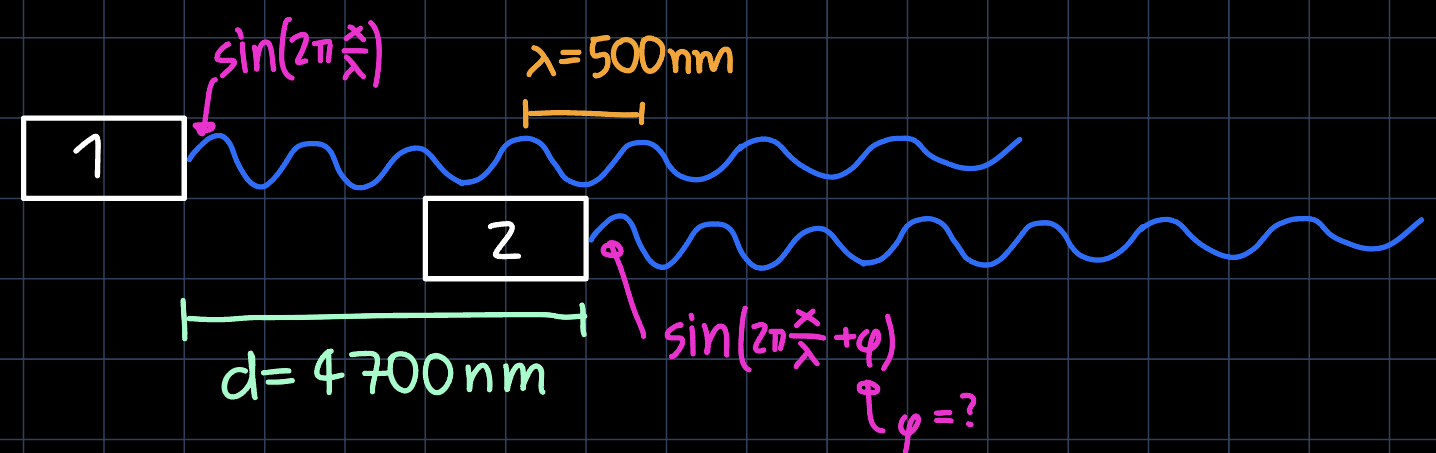
Solutions
Solution photon momentum (concept question)
Since the photons are emitted equally in all directions, the resulting force vanishes. So the force acting on the sun is $F_{res} = 0\,\mathrm{N}$.
Solution photon momentum (calculation)
- $E = h \nu = \frac{hc}{\lambda} \approx 4.96 \cdot 10^{-19}\,\mathrm{J}$, $p = \frac{h}{\lambda} \approx 1.66 \cdot 10^{-27}\,\mathrm{kg\,m/s}$
- Power is defined as energy per time, so $P = \frac{N E}{t} \approx 49.6 \,\mathrm{W}$. The momentum is obtained in the same way by $\frac{p_{laser}}{s} = \frac{N p}{t} \approx 1.66 \cdot 10^{-7}\,\mathrm{kg\,m/s^2}$.
- $p_{flugzeug} = m v = 0.01\,\mathrm{kg\,m/s}$
- For the airplane to be stopped, $p_{laser} = p_{flugzeug}$ must hold. So it takes $t = \frac{p_{flugzeug}}{p_{laser}/\mathrm{s}} \approx 6 \cdot 10^{4}\,\mathrm{s} \approx 17 \, \mathrm{h}$.
- The power of the laser is so high that the airplane would burn up relatively quickly. In addition, we would somehow have to prevent the airplane from being slowed down by air resistance and from crashing due to gravity.
Solution interference
- $A(x) = \sin(x + \pi / 2) + 5 \cos(x) = \cos(x) + 5 \cos(x) = 6 \cos(x)$
- For the two waves to be out of phase, the resulting phase difference must be $\pi$. Since the second laser is $d = 4700\, \mathrm{nm}$ away from the first, we can simply add $d$ to the argument and obtain $A_1(x) = \sin(2 \pi \frac{x}{\lambda})$ and $A_2(x) = \sin(2 \pi \frac{x+d}{\lambda}+\varphi)$. For the sum to vanish, $2 \pi \frac{x}{\lambda} + (2n + 1) \pi = 2 \pi \frac{x+d}{\lambda} + \varphi$ must hold, where $n \in \mathbb{Z}$. From this it follows directly that $\varphi = 2 \pi \frac{d}{\lambda} + (2n + 1) \pi = 2 \pi \cdot 9.4 + (2n + 1) \pi$. So one possible solution is $\varphi = 0.4 \pi$.
Week 11 - Schrödinger Equation, Operators & Particle in a Box
Theory
Operators
In quantum mechanics we often use mathematical objects that act on functions. These are called operators and are marked with a hat: $\hat{A}$. An operator $\hat{A}$ acts on a function $f(x)$ and yields a new function $\hat{A}f(x)$. For example, the derivative is an operator that acts on a function and yields its derivative as the result ('new function'):
$$ \hat{\nabla}f(x) = \frac{\mathrm{d}}{\mathrm{d}x}f(x) = f'(x) $$
If applying an operator $\hat{A}$ to a function $f$ gives back this function $f$ times a constant $\lambda$, then $f$ is called an eigenfunction of the operator $\hat{A}$ with eigenvalue $\lambda$. We write:
$$ \hat{A}f(x) = \lambda f(x) \Leftrightarrow f \text{ is an eigenfunction of } \hat{A} $$
Born interpretation & expectation values
The wave function $\Psi(x)$ is a complex function. The probability of finding a particle at a position $x$ is equal to the squared magnitude of the normalized wave function:
$$ P(\vec{r}) = \left| \Psi(x) \right|^2 $$
and is called the probability density. For the wave function to be normalized, the probability of finding the particle somewhere in space must therefore be equal to 1:
$$ \int_{-\infty}^{\infty} \left| \Psi(x) \right|^2 \mathrm{d} x = 1 $$
More generally, we can now also calculate the expectation value of an operator $\hat{A}$:
$$ \langle \hat{A} \rangle = \int_{-\infty}^{\infty} \Psi^*(x) \hat{A} \Psi(x) \mathrm{d} x $$
Here $\Psi^*(x)$ is the complex conjugate wave function. So the expectation value is the weighted average of the operator $\hat{A}$ over all possible states $\Psi(x)$ and takes on the role of the classically measured quantity.
In class we also looked at an illustration with flour:
Commutators
Unlike the numbers we use in everyday calculations, with operators the order in which they are applied matters! The dependence on the order is described by the so-called commutator:
$$ [\hat{A}, \hat{B}] = \hat{A}\hat{B} - \hat{B}\hat{A} $$
When calculating commutators, it's important to keep in mind that operators act on functions. So I recommend always calculating $ [\hat{A}, \hat{B}]f(x) $ and not $ [\hat{A}, \hat{B}] $ alone, since otherwise mistakes happen quickly. There's an example in the exercises.
Schrödinger equation
In the lecture you got to know the Schrödinger equation. It reads:
$$ \hat{H}\Psi(\vec{r},t) = \mathrm{i}\hbar\frac{\partial}{\partial t}\Psi(\vec{r},t) $$
So it describes the time evolution of a wave function $\Psi(\vec{r}, t)$. The operator $\hat{H}$ appearing in it is called the Hamiltonian (Hamilton operator) and results from the quantization of the classical energy:
$$ \hat{H} = \frac{\hat{p}^2}{2m} + V(\vec{r}) $$
where $\hat{p} = -\mathrm{i}\hbar \hat{\nabla}$ represents the momentum operator and $V(\vec{r})$ the potential.
The Schrödinger equation seems to be relatively easy to solve, especially if $\hat{H}$ doesn't depend on time. Then, as already seen in the topic of radioactivity, we obtain a solution of the form:
$$ \Psi(\vec{r}, t) = \Psi(\vec{r}, t=0) e^{- \mathrm{i} \hat{H} t/\hbar} $$
The initial function $\Psi(\vec{r}, t=0)$ now no longer depends on time and can be calculated with the time-independent Schrödinger equation:
$$ \hat{H}\Psi(\vec{r}) = E\Psi(\vec{r}) $$
where $E$ is the energy of the system in the state $\Psi(\vec{r})$. This equation is an eigenvalue equation that describes eigenfunctions $\Psi(\vec{r})$ of the Hamiltonian $\hat{H}$ with eigenvalue $E$.
Exercises
Operators & eigenfunctions
- Show that the function $f(x) = e^{kx}$ is an eigenfunction of the operator $\hat{A} = \dd{}{x}$ with eigenvalue $k$.
- Name two eigenfunctions of the operator $\hat{A} = \dd{}{x}$ with eigenvalue $\lambda = 0$?
Commutators
Calculate the commutator $ [\hat{A}, \hat{B}] $ of $\hat{A} = \hat{x}^2$ and $\hat{B} = \dd{}{x}$.
Schrödinger equation
Check that the function shown earlier:
$$ \Psi(\vec{r}, t) = \Psi(\vec{r}) e^{- \mathrm{i} \hat{H} t/\hbar} $$
satisfies the Schrödinger equation.
Expectation value
Suppose we consider a particle with the wave function $\Psi(x) = \begin{cases} A \sin(x), & \text{ for x} \in [0, \pi] \\ 0, & \text{otherwise} \end{cases}$, where $A$ is a normalization constant.
- Calculate the normalization constant $A$. Hint: $\int sin^2(x) = \frac{x}{2} - \frac{\sin(x) \cos(x)}{2}$.
- Calculate the probability of finding the particle in the interval $[0, \pi/2]$.
- Calculate the expectation value of the position operator $\hat{x}$, given by $\hat{x} = x$. Give a physical interpretation.
- Calculate the expectation value of the momentum operator $\hat{p}$, given by $\hat{p} = -\mathrm{i}\hbar \dede{}{x}$. Give a physical interpretation.
- What kind of potential could a particle with such a wave function be in?
Solutions
Solution operators & eigenfunctions
- $$ \hat{A}f(x) = \dd{}{x} e^{kx} = k e^{kx} = kf(x) $$
- Any constant $c$ is an eigenfunction of $\dd{}{x}$ with eigenvalue $\lambda = 0$, since $\hat{A}c = 0c = 0$.
Solution commutators
As explained at the beginning, it's important to apply the commutator to a function. So we calculate:
$$ \begin{aligned} [x^2, \dd{}{x}] f(x) &= x^2 \dd{}{x} f(x) - \dd{}{x} \left( x^2 f(x) \right) \\ &= x^2 \dd{}{x} f(x) - \dd{}{x} x^2 f(x) \\ &= x^2 f'(x) - 2xf(x) - x^2 f'(x) \\ &= -2xf(x) \end{aligned} $$
Where we used the product rule for the derivative.
Solution Schrödinger equation
We calculate the derivative:
$$ \dede{}{t} \Psi(\vec{r}) e^{- \mathrm{i} \hat{H} t/\hbar} = - \frac{\mathrm{i}}{\hbar} \hat{H} \Psi(\vec{r}) e^{- \mathrm{i} \hat{H} t/\hbar} $$
and substitute this into the Schrödinger equation:
$$ \begin{aligned} \hat{H} \Psi(\vec{r}, t) = \mathrm{i}\hbar\frac{\partial}{\partial t}\Psi(\vec{r},t) \\ \Leftrightarrow \hat{H} \Psi(\vec{r}) e^{- \mathrm{i} \hat{H} t/\hbar} = \mathrm{i} \hbar \cdot \left(-\frac{\mathrm{i}}{\hbar} \hat{H} \Psi(\vec{r}) e^{- \mathrm{i} \hat{H} t/\hbar} \right) \\ \Leftrightarrow \hat{H} \Psi(\vec{r}) e^{- \mathrm{i} \hat{H} t/\hbar} = \hat{H} \Psi(\vec{r}) e^{- \mathrm{i} \hat{H} t/\hbar} \end{aligned} $$
So the Schrödinger equation is satisfied.
Solution expectation value
L1. The normalization constant $A$ follows from the normalization condition
$$ \int_{-\infty}^{\infty} \left| \Psi(x) \right|^2 \mathrm{d} x = 1$$
We calculate:
$$ \int_{-\infty}^{\infty} \left| \Psi(x) \right|^2 \mathrm{d} x = \int_{0}^{\pi} A^2 \sin^2(x) \mathrm{d} x = A^2 \frac{\pi}{2} $$
which gives us $A = \sqrt{\frac{2}{\pi}}$.
L2. The probability of finding the particle in the interval $[0, \pi/2]$ is $50\%$, since it is exactly half of the interval $[0, \pi]$ and the wave function $\Psi(x)$ is symmetric about $\pi/2$. But we can also calculate it by:
$$ \int_{0}^{\pi/2} \left| \Psi(x) \right|^2 \mathrm{d} x = \int_{0}^{\pi/2} \frac{2}{\pi} \sin^2(x) \mathrm{d} x = \frac{2}{\pi} \frac{\pi}{4} = \frac{1}{2} $$
L3. The expectation value of the position operator $\hat{x}$ is:
$$ \langle \hat{x} \rangle = \int_{-\infty}^{\infty} \Psi^*(x) \hat{x} \Psi(x) \mathrm{d} x = \int_{0}^{\pi} \frac{2}{\pi} \sin^2(x) x \mathrm{d} x = \frac{2}{\pi} \frac{\pi^2}{4} = \frac{\pi}{2} $$
So on average the particle is at $x = \pi/2$, which is what we would also expect classically.
L4. The expectation value of the momentum operator $\hat{p}$ is:
$$ \begin{aligned} \langle \hat{p} \rangle &= \int_{-\infty}^{\infty} \Psi^*(x) \hat{p} \Psi(x) \mathrm{d} x = \int_{0}^{\pi} \frac{2}{\pi} \sin(x) \left(-\mathrm{i}\hbar \dede{}{x}\right) \sin(x) \mathrm{d} x \\ &= - \mathrm{i} \hbar \frac{2}{\pi} \int_{0}^{\pi} \sin(x) \cos(x) \mathrm{d} x = 0 \end{aligned}$$
So the expectation value of the momentum operator is $0$. So on average the particle has no momentum, which is what we would also expect classically, since it is a standing wave.
L5. First we see that the particle can only move in one dimension, since there is only one position variable $x$. So it is also a one-dimensional potential. Since the wave function vanishes outside the region $[0, \pi]$, the potential outside this region must be infinitely large, so that the probability of finding the particle there vanishes. Inside the region $[0, \pi]$ the potential is constant, the wave function is an eigenfunction of $\dede{^2}{x^2}$ and thus of $\hat p ^2$. So it is a potential that corresponds exactly to the potential for the particle in a one-dimensional box considered in the exercises.
Week 12 - Hydrogen Atom & Atomic Terms
Theory
Hydrogen atom & orbitals
You saw in the lecture that the (time-independent) Schrödinger equation for the hydrogen atom can be solved analytically. Its solutions are one-electron wave functions and are also called orbitals. Since we cannot solve the Schrödinger equation analytically for atoms with several electrons, we often approximate them with the solutions of the hydrogen atom. These solutions are not exact, but they are very good and help us understand the electronic structure of atoms.
The solutions were separated into a product of a radial part, i.e. dependent on the distance from the nucleus, and an angular part, i.e. dependent on the angles $\theta$ and $\phi$. The exact form isn't that important, but the physical interpretation of the nodal surfaces helps us (especially in later lectures, AC, OC) to understand the reactivity of certain molecules. At the nodal surfaces the wave function vanishes, and so does its squared magnitude. According to the Born interpretation, the probability of finding the electron there is therefore 0!
Pauli Aufbau principle
Since electrons are fermions, two electrons cannot agree in all four quantum numbers $n, l, m_l, m_s$. Furthermore, $l<n$ and $m_l \in {-l, -l+1, \dots, l-1, l},$ as well as $m_s \in {-\frac{1}{2}, \frac{1}{2}}$ must hold. Filling the orbitals, however, isn't quite as simple as just following the order of the principal quantum number $n$. The order is shown as follows:
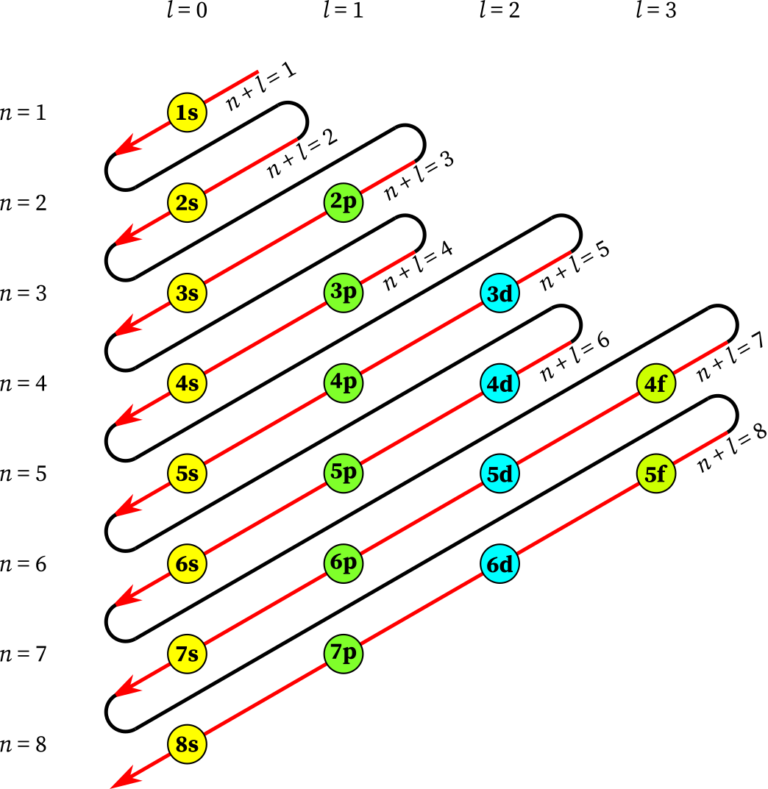
The orbitals with the same quantum number $l$ are also called subshells and can be filled with $2(l+1)$ electrons. The orbitals with the same principal quantum number $n$ are also called shells.
Term symbols
Recipe for determining the term symbol:
- Fill the orbitals according to the Pauli principle (best to draw it). Only the valence electrons need to be considered, since full subshells don't contribute to the total angular momentum.
- Add up the orbital angular momenta of the individual electrons $m_l$ to the total orbital angular momentum $L$. In the ground state, the orbitals are filled such that $L$ is maximal.
- Add up the spin angular momenta of the individual electrons $m_s$ to the total spin angular momentum $S$. In the ground state, the orbitals are filled such that $S$ is maximal.
- Combine the total orbital angular momentum $L$ and the total spin angular momentum $S$ to the possible values of the total angular momentum $J = L+S, L+S-1, \dots, |L-S|$. In the ground state, $$J = \begin{cases} L+S & \text{if subshell more than half full} \\ |L-S| & \text{if subshell less than half full} \end{cases}$$
- The term symbol is then $^{2S+1}L_J$ (or several, if there are different values for $J$)
Example for the beryllium atom:
- 1s$^2$ 2s$^2$
- $m_{l,1} = 0, m_{l,2} = 0, m_{l,3} = 0, m_{l,4} = 0$ since all are in s orbitals. So $L = 0$ as well
- $m_{s,1} = +\frac{1}{2}, m_{s,2} = -\frac{1}{2}, m_{s,3} = +\frac{1}{2}, m_{s,4} = -\frac{1}{2}.$ So $S = 0$ as well
- $J = 0 + 0 = 0$
- The term symbol is $^1\mathrm{S}_0$
Exercises
Term symbols
Determine the term symbols for the following atoms in the ground state:
a) Al
b) As
c) Which of the following term symbols are possible and why/why not?
- $^3\mathrm{P}_2$
- $^0\mathrm{S}_0$
- $^7\mathrm{S}_3$
- $^1\mathrm{S}_1$
Fundamentals and models of QM (exam HS10)
In a first experiment, you measure the momentum of an electron in the $x$-direction and then the momentum in the $z$-direction. In a second experiment, you perform these measurements in exactly the reverse order.
a) Formulate these two measurements in the language of QM (with operators).
b) State what the difference between the measurement results is and justify your answer mathematically!
A proton is in a one-dimensional box of length $d = 1.5\, \mathrm{fm}$.
c) Calculate the wavelength of the electromagnetic radiation emitted when the proton undergoes a transition from $n = 2$ to $n = 1$.
d) In which region of the electromagnetic spectrum does the emitted radiation lie?
Assuming a quantum mechanical harmonic oscillation, calculate the minimum excitation energy from the ground state to the first excited state for
e) a quartz crystal oscillator of a watch at $33 \, \mathrm{kHz}$;
f) the bond between two oxygen atoms in the oxygen molecule. The force constant is $k = 1177 \, \mathrm{N/m}$.
Tip: As the mass, use the reduced mass for two particles $1$ and $2$: $\mu = \frac{m_1 m_2}{m_1 + m_2}$, and calculate the mass of an oxygen atom from the molar mass.
Solutions
Solution term symbols
a) Al: $[\mathrm{Ne}] 3s^2 3p^1 \Rightarrow L = 1, S = \frac{1}{2} \Rightarrow ^2P_{\frac{1}{2}}$
b) As: $[\mathrm{Ar}] 3d^{10} 4s^2 4p^3 \Rightarrow L = 0, S = 3/2 \Rightarrow ^4S_{\frac{3}{2}}$
c) Remember that the term symbol is $^{2S+1}L_J$, where $S$ is the total spin angular momentum, $L$ the total orbital angular momentum and $J$ the total angular momentum. The possible values for $J$ are $J = L+S, L+S-1, \dots, |L-S|$. Thus:
- possible, e.g. for the ground state of sulfur
- not possible, since $2S+1 \geq 1$ must hold.
- possible, e.g. for the ground state of chromium
- not possible, since $\mathrm{S} \Leftrightarrow L = 0$ and $2S+1 = 1 \Rightarrow S = 0,$ but $J = 1,$ which leads to a contradiction.
Solution fundamentals and models of QM (exam HS10)
a) The operators are written down from the point of view of the wave function $\psi_{el}$ in the given order, since they are applied in this order (i.e. exactly the reverse of how we would write it down):
- Measurement (first momentum in $x$-direction, then momentum in $z$-direction) $ M_1: \hat{p}_z \hat{p}_x \psi_{el} $
- Measurement (first momentum in $z$-direction, then momentum in $x$-direction) $ M_2: \hat{p}_x \hat{p}_z \psi_{el} $
b) We get the difference from the commutator of the two operators $\hat{p}_z$ and $\hat{p}_x$. Since they commute, the commutator is equal to zero. So there is no difference between the two measurement results.
c) The energy levels of the particle in a box are known:
$$E_n = \frac{n^2 h^2}{8 m_p d^2} \Rightarrow E_{2 \rightarrow 1} = 3 \frac{h^2}{8 m_p d^2}$$
$$\lambda = \frac{hc}{E_{2 \rightarrow 1}} \approx 4.54 \cdot 10^{-15} \, \mathrm{m}$$
d) The emitted radiation has a very short wavelength and lies in the range of $\gamma$-radiation.
e) With the solution of the harmonic oscillator:
$$E_n = \left(n + \frac{1}{2}\right) h \nu$$
we directly obtain:
$$E_{0 \rightarrow 1} = h \nu \approx 2.19 \cdot 10^{-29} \, \mathrm{J}$$
f) Since the bond can be modeled as a harmonic oscillator, the same formula as in e) applies. We get the frequency from the force constant $k$:
$$\nu = \frac{1}{2 \pi} \sqrt{\frac{k}{\mu}}$$
The reduced mass between two oxygen atoms of mass $m_{O} \approx 16 \, \mathrm{u}$ is:
$$\mu = \frac{m_{O}^2}{2 m_{O}} = \frac{m_{O}}{2}$$
This gives:
$$E_{0 \rightarrow 1} = h \nu = h \frac{1}{2 \pi} \sqrt{\frac{k}{\mu}} = \frac{h}{2 \pi} \sqrt{\frac{2 k}{m_{O}}} \approx 3.14 \cdot 10^{-20} \, \mathrm{J}$$
Week 13 - Harmonic Oscillator
Theory
Harmonic oscillator
Definition
A harmonic oscillator is a system described by the following differential equation:
$$\frac{\mathrm d^2 f(x)}{\mathrm d x^2} = - \omega^2 f(x)$$
where $\omega$ is a constant. The solution of this differential equation is:
$$f(x) = A \sin(\omega x) + B \cos(\omega x)$$
and describes a harmonic oscillation with the angular frequency $\omega$.
We get this differential equation when a force law of the form $F(x) = - k (x - x_{\mathrm e})$ holds, i.e. the force is proportional to the displacement from an equilibrium position $x_{\mathrm e}$. The constant $k$ is the force constant and $\omega = \sqrt{\frac{k}{m}}$ is the angular frequency that already appeared above. The corresponding potential is then $V(x) = \frac{1}{2} k (x - x_{\mathrm e})^2 ,$ which is what we will usually encounter.
Motivation
Since nature strives for the state of lowest energy, it makes sense that a particle in a potential will be found at least at a local minimum. The harmonic oscillator is an important model in physics, since small displacements from an equilibrium state can be approximated by a harmonic potential. If we now consider a small perturbation from the equilibrium state and approximate the potential by a second-order Taylor expansion, we obtain a harmonic potential:
$$V(x) \approx V(x_{\mathrm e}) + \frac{1}{2} V''(x_{\mathrm e}) (x-x_{\mathrm e})^2$$
Since we can choose the zero point of the potential freely, we can set $V(x_{\mathrm e}) = 0$ and obtain:
$$V(x) \approx \frac{1}{2} V''(x_{\mathrm e}) (x-x_{\mathrm e})^2$$
Harmonic oscillator in quantum mechanics
If we consider the harmonic oscillator in quantum mechanics, we need the time-independent Schrödinger equation:
$$\left( - \frac{\hbar^2}{2 m} \frac{\mathrm d^2}{\mathrm d x^2} + \frac{1}{2} k x^2 \right) \psi(x) = E \psi(x)$$
The solutions of this differential equation are nicely complicated and don't interest us directly. What's important are the eigenvalues we get for the energy:
$$E_n = \hbar \omega \left( n + \frac{1}{2} \right) = h \nu \left( n + \frac{1}{2} \right)$$
where $n$ is a natural number and $\nu = \frac{1}{2 \pi} \sqrt{\frac{k}{m}}$ is the frequency of the harmonic oscillation. So in the harmonic potential only certain frequencies can occur, which can also be observed experimentally in infrared spectroscopy.
Exercises
Comprehension questions on the harmonic oscillator
a) A second-order Taylor expansion has the form:
$$f(x) \approx f(x_0) + f'(x_0) (x-x_0) + \frac{1}{2} f''(x_0) (x-x_0)^2$$
In the theory part, however, we said that the second-order Taylor expansion of $V(x)$ has the form
$$V(x) \approx V(x_{\mathrm e}) + \frac{1}{2} V''(x_{\mathrm e}) (x-x_{\mathrm e})^2$$
What happened to the term $V'(x_{\mathrm e}) (x-x_{\mathrm e})$?
b) What is the difference between the harmonic oscillator in classical mechanics and in quantum mechanics?
c) Does the approximation of the hydrogen bond by a harmonic potential work better for small or for large displacements? Justify your answer.
d) If the hydrogen bond really could be described by a harmonic potential, could it then dissociate? Justify your answer.
Dissociation of hydrogen (exam FS17)
Hydrogen molecules are formed from a mixture of H, D and T atoms with relative abundances of $60 \%$, $30 \%$ and $10 \%$. All atoms are used up, and not only $\mathrm{H}_2$ molecules are formed, but also D- and T-containing isotopomers of $\mathrm{H}_2$.
a) List all hydrogen isotopomers that can be formed from the mixture and give their relative abundances.
The dissociation energy $D_0$ of $\mathrm{H}_2$ is $7.17466 \cdot 10^{-19} \, \mathrm{J}.$ The harmonic vibrational frequency of $\mathrm{H}_2$ is $\mu = 1.3176 \cdot 10^{14} \, \mathrm{Hz},$ and the equilibrium distance of $\mathrm{H}_2$ is $R_e = 0.739 \cdot 10^{-10} \, \mathrm{m}.$
b) Sketch in a diagram the Born-Oppenheimer potential energy $V(R)$ of $\mathrm{H}_2$ as a function of the internuclear distance $R$ between the two protons. Mark the dissociation energies $D_0$ and $D_e$ in this diagram.
c) Determine the value of $D_e$ as accurately as possible.
d) Determine the harmonic vibrational wavenumber of $\mathrm{H}_2$ and $\mathrm{HD}$ and estimate the dissociation energy $D_0$ of $\mathrm{HD}$ as accurately as possible with the information above.
e) Which of the isotopomers determined in a) has the highest dissociation energy $D_0 \mathrm{?}$
Solutions
Solution comprehension questions on the harmonic oscillator
a) Since $V(x)$ has a local minimum at $x_{\mathrm e}$, $V'(x_{\mathrm e}) = 0$ must hold. So the term $V'(x_{\mathrm e}) (x-x_{\mathrm e})$ drops out.
b) For the harmonic oscillator in classical mechanics, the energy is continuous, while in quantum mechanics it is discrete, i.e. it can only take certain values.
c) The approximation works better for small displacements, since the higher-order terms in the Taylor expansion can then be neglected. If $x^2$ is small, then $x^3$ is even smaller and $x^4$ smaller still, etc.
d) It could not dissociate, since the acting force is proportional to the displacement. If the displacement becomes large, the force becomes large and pulls the molecule back again. A state in which the force between the atoms vanishes, and the molecule would thus dissociate, is never reached.
Solution dissociation of hydrogen (exam FS17)
a) The isotopomers $\mathrm{H}_2$, $\mathrm{HD}$, $\mathrm{HT}$, $\mathrm{D}_2$, $\mathrm{DT}$ and $\mathrm{T}_2$ can be formed. The relative abundances are:
| Isotopomer | Abundance |
|---|---|
| $\mathrm{H}_2$ | $0.6^2 = 0.36$ |
| $\mathrm{HD}$ | $2 \cdot 0.6 \cdot 0.3 = 0.36$ |
| $\mathrm{HT}$ | $2 \cdot 0.6 \cdot 0.1 = 0.12$ |
| $\mathrm{D}_2$ | $0.3^2 = 0.09$ |
| $\mathrm{DT}$ | $2 \cdot 0.3 \cdot 0.1 = 0.06$ |
| $\mathrm{T}_2$ | $0.1^2 = 0.01$ |
As a check, the sum of the abundances is: $0.36 + 0.36 + 0.12 + 0.09 + 0.06 + 0.01 = 1$.
b)
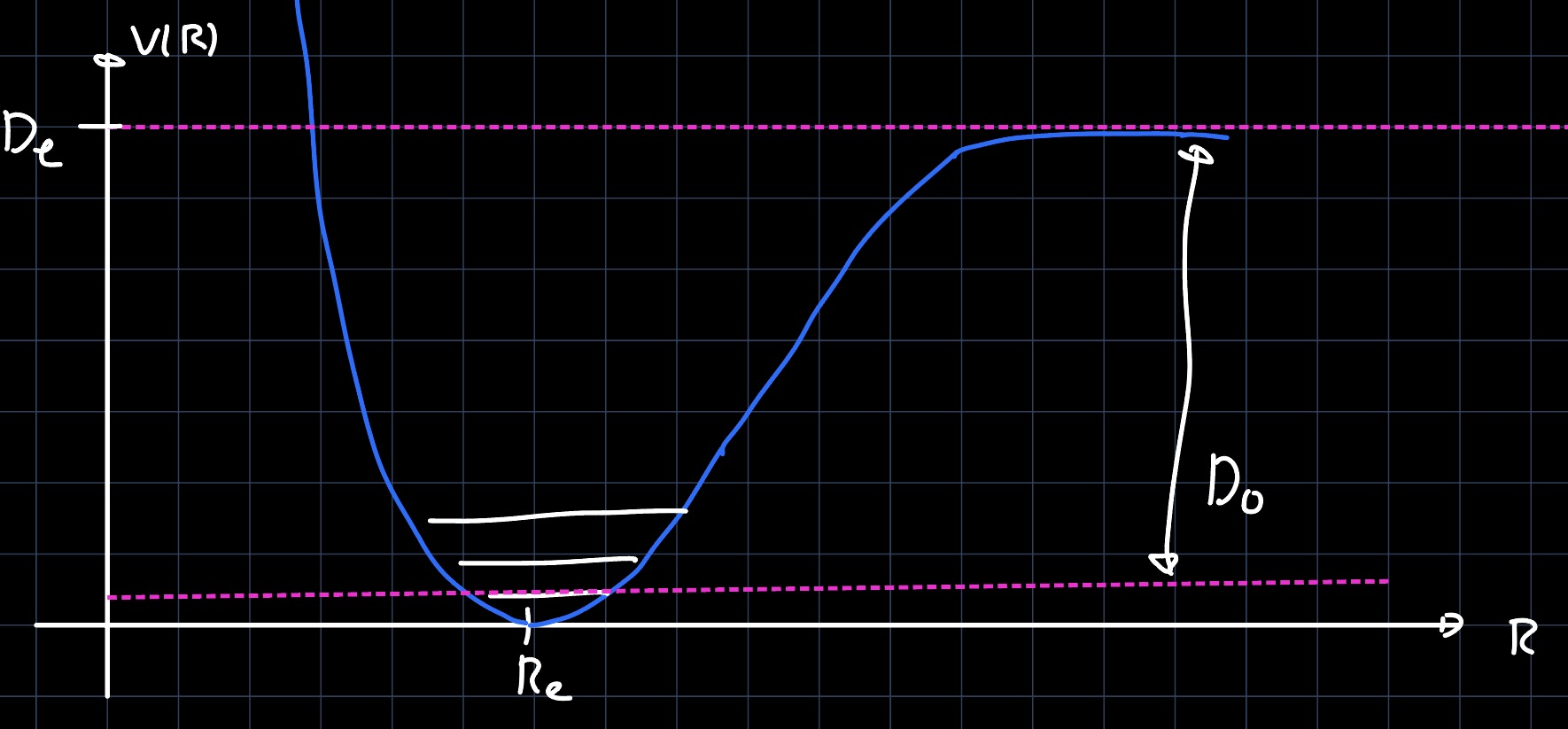
c) $D_e \approx D_0 + \frac{1}{2} h \nu \approx 7.6112 \cdot 10^{-19} \, \mathrm{J}$
d) We get the harmonic vibrational wavenumber for $\mathrm{H}_2$ from the vibrational frequency $\nu \approx 1.3176 \cdot 10^{14} \, \mathrm{Hz}$:
$$\tilde{\nu}_{\mathrm{H}_2} = \frac{\nu}{c} \approx 4395\, \mathrm{cm}^{-1}$$
We get the harmonic vibrational wavenumber for $\mathrm{HD}$ via the formula $\nu = \frac{1}{2 \pi} \sqrt{\frac{k}{\mu}}$ and the assumption that the force constant $k$ stays the same:
$$\tilde{\nu}_{\mathrm{HD}} = \sqrt{\frac{m_n + 2 m_p}{2(m_n+m_p)}} \tilde{\nu}_{\mathrm{H}_2} \approx 3108\, \mathrm{cm}^{-1}$$
So for the dissociation energy of $\mathrm{HD}$ we obtain:
$$D_{0, \mathrm{HD}} \approx D_{e, \mathrm{H}_2} - \frac{1}{2} h c \tilde{\nu}_{\mathrm{HD}} \approx 7.3025 \cdot 10^{-19} \, \mathrm{J}$$
e) $D_0$ becomes maximal when $\tilde{\nu}$ is minimal. This is the case when $\frac{{\mu}_{\mathrm{H}_2}}{{\mu}_\mathrm{XY}}$ is minimal. Substituting $m_X, m_Y$, we obtain:
$$\frac{\frac{m_p}{2}}{\frac{m_X m_Y}{m_X + m_Y}} = \frac{m_p}{2} \frac{m_X + m_Y}{m_X m_Y}$$
which becomes minimal exactly when $m_X = m_Y = m_p$. So $\mathrm{H}_2$ is the isotopomer with the highest dissociation energy.
Week 14 - Exam Preparation
Exam-relevant material
In the lecture slides, I have marked which parts I consider relevant for the exam and what you should simply have seen once, but are not expected to be able to reproduce. This document is available here. No guarantee of accuracy
Exam preparation
General - organizational
Since you take the Basisprüfung as a block, you won't have exams until the summer. But that doesn't mean you shouldn't start preparing in the winter already! I recommend reviewing the material you've learned during the lecture-free period and writing summaries if needed. I would also go through the exercises again, since they are also part of the exam material.
Sometime in the middle of the spring semester, you'll get the announcement by email that you can register for the exams. With a few clicks in myStudies you're registered and don't have to worry about anything else. The exact exam dates are announced about 2 months later.
After the spring semester, the study phase begins. It is very long, so it's a good idea not to burn all your energy right at the start, and maybe take 1-2 weeks of vacation first. If you're tired and overloaded, studying doesn't do much good. After that, it's important to make a study plan to keep track of the many subjects. For this, and for exam preparation in general, ETH provides you with counseling and resources. Here, too: take it seriously not to overload yourselves, and treat yourselves to weekends and breaks!
ACPC I exam - organizational
- The exam lasts 60 minutes and there are (usually) 3 exercises, each roughly the length of an exercise sheet problem. So there's quite a bit of time pressure.
- PC0 is examined together with PCI - Thermodynamics. You write the PC0 exam first, then there's a break of a few minutes before the PCI exam.
- The exam is open-book. So you can bring all written materials, as well as any (non-internet-capable) calculator.
- Usually there's one exercise on radioactivity, one on QM, and the third varies (e.g. on the (an)harmonic oscillator, on atomic terms, etc.)
ACPC I specific tips - studying
- There are many old exams in the VCS exam collection. These are very helpful for practicing. The exams are usually structured very similarly.
- When solving old exams, it's important to also correct them. Be strict with yourselves and solve the exercises you got wrong again while 'peeking' at the sample solution.
- Don't only study with old exams, but also look at the theory again. The exam can suddenly look a bit different.
ACPC I specific tips - exam
- As already emphasized several times: Get yourself a good calculator and also use its advantages! Don't forget to watch Raphael's YouTube video on this.
- One hour is barely enough to solve the whole exam. So you have to set priorities and first solve the exercises you're best at. It's usually worth leaving out the last few subtasks of an exercise: these are often harder and only give a few points.
- Don't worry while studying if you can't solve the exams in the given time. Usually you pass with about $40\%$ of the points and get the $6$ with $2/3$ of the points.

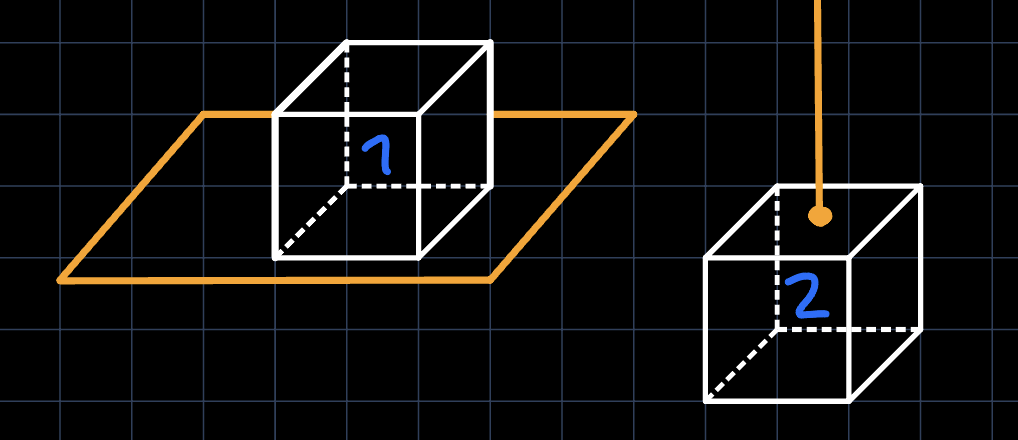

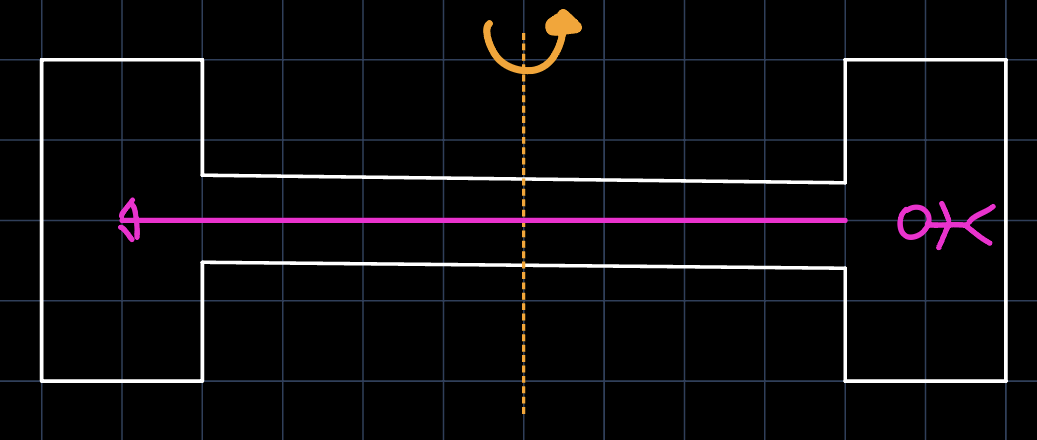
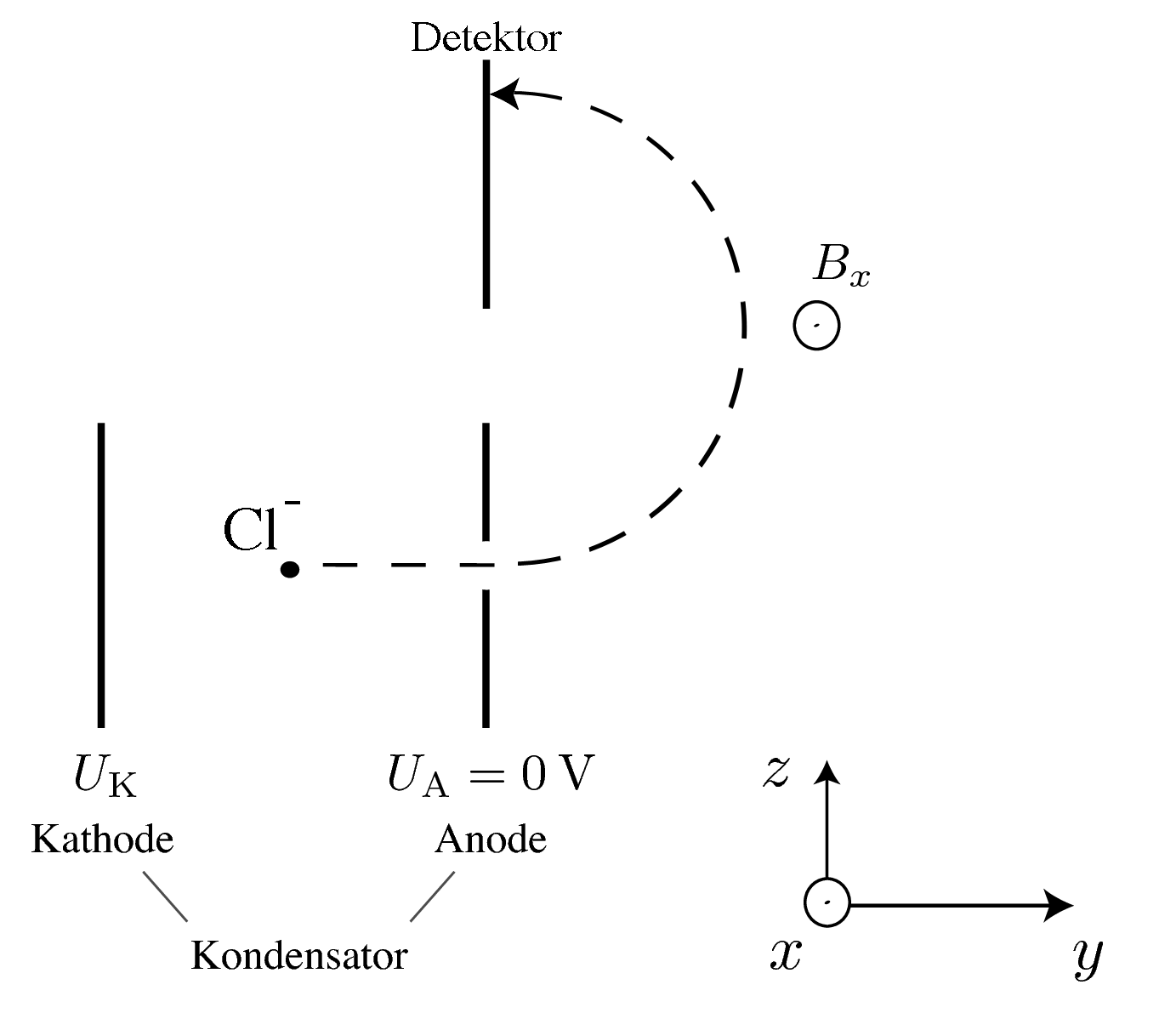
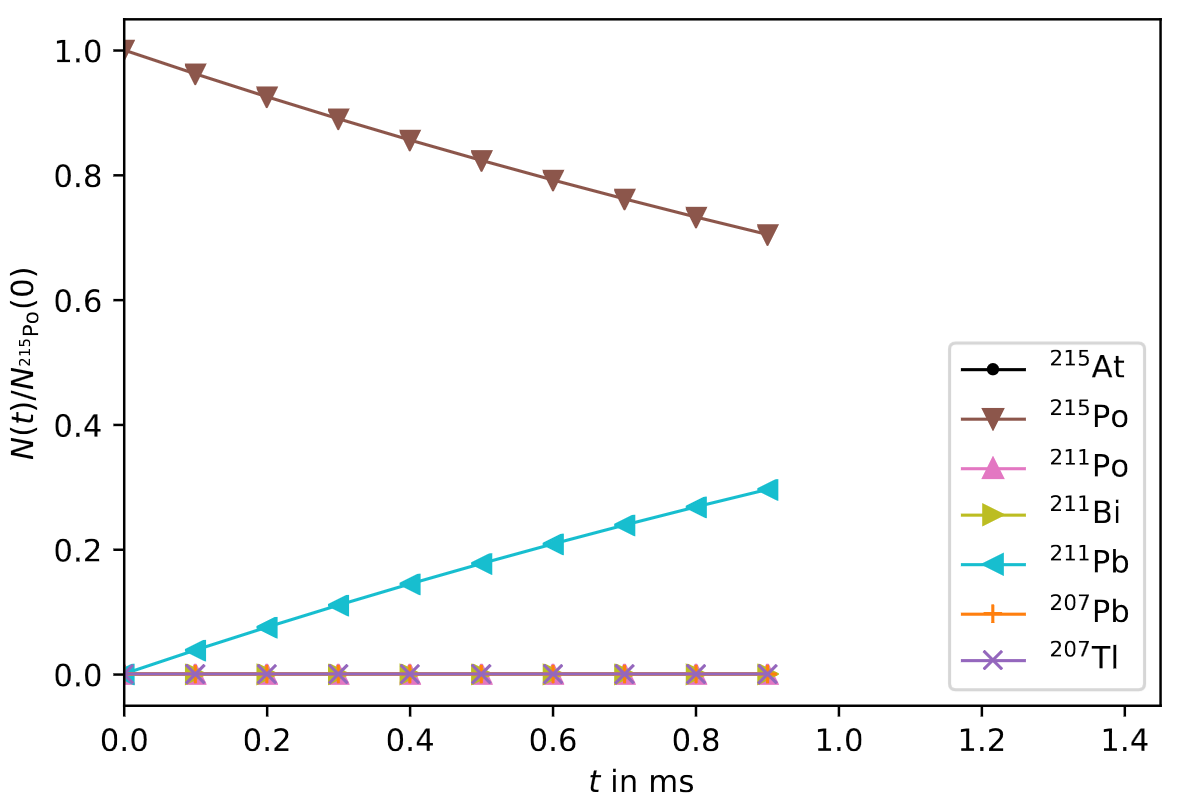
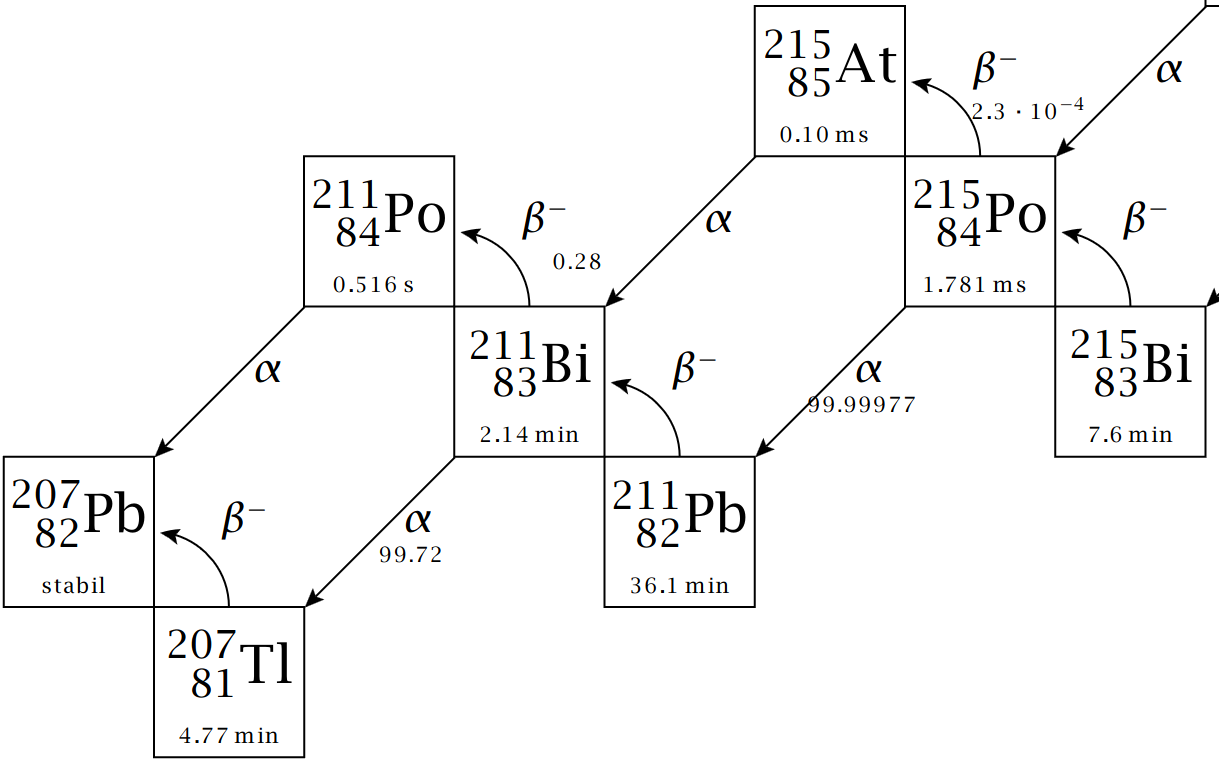
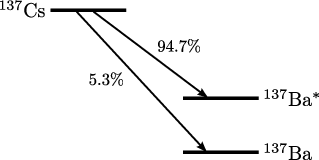
 The minimum energy needed to release an electron from a metal surface is the work function $E_{\rm Aus}$ and represents the binding energy of the electron in the metal. When a metallic surface is irradiated with monochromatic light, electrons are emitted if the absorbed energy exceeds the work function. The work function of most metals lies in the ultraviolet to visible range of the electromagnetic spectrum.